• Skip to main content

Metacoin

Covering Bitcoin, the Blockchain, Altcoins, and Fintech

  • Start Here
  • Links
  • Disclosures
  • NFTs
  • Collezione

Oct 15 2020

Airdrop Watch: Here’s One Called…COYFI, and another called ARBISWAP

We found these airdrops and thought we’d send them along.

$COYFI is the name of the first one and it appears to want to offer some of the benefits of $YFI, but, well, it’s an airdrop, so they’re just getting going.

Here’s a screenshot:

Use this link and get 0.1 of these for free: COYFI Airdrop.

The other is called $ARBISWAP and the link *may* require a purchase in order to get free coins. Here it is: ARBISWAP Airdrop. You’ll be directed to Telegram where you follow a few steps.

Bear in mind, we’re not sure how any of these will fare.

* we take no responsibility for your success or failure with any of these. If you think you’ll get rich, we direct you to the “Rug Pull” of a couple weeks back.

Written by David Van de Walle · Categorized: Airdrop

Oct 14 2020

Video: We Explain ‘Impermanent Loss’

One of our investments — which we talked about a few weeks ago on this post — is a token called $KIMCHI.

Let’s say that our loss is your gain: we didn’t take a bath, but we did lose. The loss is “impermanent,” as we explain here.

We need to let our Kimchi…uh…ferment.

Written by David Van de Walle · Categorized: Uncategorized

Oct 05 2020

Anatomy of a Rug Pull

We saw this one coming a mile away: Apy.center was what is known as a “rug pull.” Investors saw the rug pulled out from under them, and, unless you were one of the early ones, your money is pretty much gone.

So…what happened?

I don’t think “.pull” is a TLD extension…

Step One: The Recruitment

It launched sometime early in the morning Friday, October 2, as a yield farm on steroids. In the interest of public service — we should note that we’ve done a few experiments like this during our three years blogging here — we decided to gamble what amounted to a family fast food meal on the Uniswap Pool behind $CAPY. We were also investing in a platform that was roughly 12 hours old.

We were 12 hours too late.

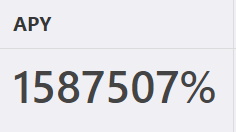
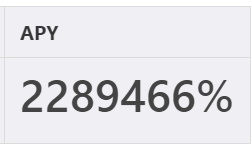
Here was the interest rate promised when we got in:

Not sustainable.

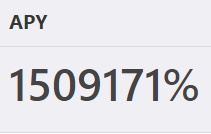
And here was the interest rate just two hours later:

Still not sustainable.

Step Two: The Contract’s 72-Hour Rule (i.e. The Setup)

This is where everyone who was recruited into this fast-growing pool saw stars in their eyes: your money is locked for 72 hours. You can’t get any of the gains out til then, so you have no choice but to watch and wait and hope and pray that the rug won’t get pulled out from under you.

New money was indeed flowing in, to the tune of a half-million TVL (total value locked) by Saturday morning (36 hours after launch).

Yeah, it’s a scam.

One of the fastest-growing Telegram channels we’ve ever seen served as an additional recruitment tool, with more money flowing in and, at around the same time of the above snapshot, interest rates promised that were still huge.

Rug Pull Imminent…

The clock/time bomb was ticking, but Sunday still saw huge POTENTIAL returns:

5pm, Central Time (US), APY

With the first investors just a few hours away from being able to take their investments out, it was just a matter of time. Here’s a TVL snapshot from Sunday evening, US Central Time:

It’s coming…

And here’s this morning’s post-rug-pull TVL snapshot (we slept in til 6:15, since we were powerless to stop any movement; our funds were locked so the only potential gains, all on paper, weren’t real):

That’s a big drop, eh?

AND, just moments ago, 9:25 a.m. Central Time in the US:

It keeps on dropping…

What Have We Learned?

Chasing quick returns? That’s human nature. Looking at nutty interest rates that seem impossible, you may have succumbed to the masses: “I want some of that.”

The creators of this mystery coin set it up in such a way that, while the code appeared to be air-tight, there was no possible way to make any money unless you were one of the first users. No one in their right mind was going to hold onto their gains for any longer than they had to, and the new money that went in was obviously going to pay the old money that was in first. The first few investors — who were likely also the creators of this coin — played psychology, word-of-mouth marketing, and the lure of insane, out-of-this-world returns to get new investors on board fast enough to ensure that maybe the first 5 investors were getting mass profits.

It’s a classic Ponzi scheme.

Again, DYOR, and Don’t Be Surprised if You Get #REKT.

Be careful out there, folks.

Written by David Van de Walle · Categorized: CAPY, Uncategorized · Tagged: bitconnect, rekt, rug pull

Oct 01 2020

More DeFi Food: A Deep Dive into (A Plate Full of) TACOs

Really, #DeFi developers, do all of these things HAVE TO BE NAMED AFTER FOOD?

Well, they don’t HAVE to be, but it appears that some of the more interesting concepts in DeFi (Decentralized Finance) actually are named after food. Like $TACO, a platform that we learned about when we were trading $SHRIMP and $SUSHI.

More Than a Cute Logo and a Clever Name

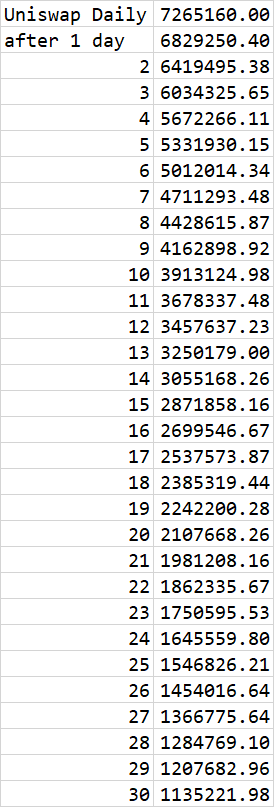
TACOs has turned their brand of deflationary token launch into a game. They have set aside a large chunk of the token supply to be burned: 6 percent of the Uniswap pool gets torched daily.

From taconomics.io

(Nobody likes to eat burned tacos, but…)

Hey, this does appear to be sorta clever: no more TACOs can be created, and the supply gets “crunched” so that your TACOs become more valuable over time.

It works like this, and we were able to confirm through a couple of “trades” of our own yesterday:

  1. You decide if you want to “crunch” the outstanding tokens and claim 10 percent of the amount being crunched;
  2. You pay the gas — we paid $3.12 on one of our transactions yesterday — and have to calculate whether the gas makes up for the value of the tokens;
  3. You make the transaction and see the 10 percent in your wallet.

But here’s where it gets interesting: you may decide that the gas price is totally worth it, despite only getting (in the above scenario) 42 tokens added to your balance. Given the recent price of just short of 7 cents per token, you’re paying a little more than $3 to get 42 tokens. SO you’ve covered your costs.

7 cents a token, eh?

In another case, when we decided to say “what the heck?,” we paid 10 cents a token for another 60. We think there’s potential with this platform — in fact, we did the math and the burn rate — or “crunch rate,” even “crunch rate supreme” — might mean that supply gets tremendously sliced over the next month.

Day 30, 6 million burned.

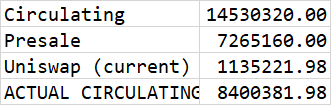
This means that on Day 30, $TACO has nearly half of its coins destroyed.

Only 8.4 million left on Day 30

OR…if you check the contract, you realize it’s not moving THAT quickly…

From Etherscan

It’s still early and there are some kinks to work out — and the website itself is a little murky on details. BUT, if you’re willing to play a game, and don’t mind the potential that you could be playing a game that could be worthless, spend a little time with a plate full of TACOs.

Written by David Van de Walle · Categorized: DeFi, Shrimp, Sushi, tacos

Sep 28 2020

Shrimping Experiment: Time to Roll the Dice

As fate would have it, we now have the opportunity to shift one of our DeFi experiments from the world of food — or at least tokens that are named after food — to the world of gambling.

Yes, it’s time to roll the dice. Literally: we’re going to move our $SHRIMP to $DICE.

Screenshot from Telegram

The Shrimp.finance team announced overnight (our time; we’re on Central Time, USA) that they were moving their development efforts to Dice.finance; you can read what they said on Medium here.

How This Could Impact You…

If we’re correct in our research — and based on what we’ve learned talking to others who have followed both $SHRIMP and $DICE — this amounts to a “burn” of the Shrimp token. And you can take it directly from the blog post:

Fair enough.

As the Medium post tells us, if you had Shrimp, they’ll buy it back at $2.50 each. The buyback, though, is in $DICE, which you need to leave on the platform for six months in order to get rewards — which will be on top of the value of the tokens you deposit.

Betting on Horse…or Jockey?

In our opinion, you’re betting a little on the horse — if you’re in the USA, for instance, you know how prevalent all kinds of gambling are — but a lot on the jockey: XiXi Huang.

Cute Logo.

Huang appears to be a rather innovative character, and he’s somewhat active on Telegram; his interest in making this move appears to be driven by the desire to focus on the growing gambling sector, and the location of Dice (Macau).

The Dice price, though, is pegged for this swap at $165; that’s a far cry from the trading value earlier this morning of $56.25.

Dice Price is Nice (Today, at least, if you’re a HODLer).

Next Steps?

We will keep you posted; we’re still investigating the opportunities here and still processing how to move things from our meager Shrimp holdings.

Again, stay safe, do your own research, and be prepared to watch any of these projects go belly up, too. That’s always a risk — though we hope you hit it big with one of these, it’s possible that you could get rekt, too.

Final Note: A Warning About Dice on YoBit

You can find a few coins marked “DICE” out there; one such is the DICE that were awarded to YoBit users. Be sure you’re looking in the right place for your Dice. Visit the buyback site from Dice itself here: buyback.dice.finance.

Written by David Van de Walle · Categorized: DeFi, Dice, Shrimp

  • « Go to Previous Page
  • Page 1
  • Interim pages omitted …
  • Page 7
  • Page 8
  • Page 9
  • Page 10
  • Page 11
  • Interim pages omitted …
  • Page 37
  • Go to Next Page »

Copyright © 2026 · Altitude Pro on Genesis Framework · WordPress · Log in