• Skip to main content

Metacoin

Covering Bitcoin, the Blockchain, Altcoins, and Fintech

  • Start Here
  • Links
  • Disclosures
  • NFTs
  • Collezione

Sep 24 2020

Could Dego Be the Next Big Thing?

We just learned about another one, and this #DeFi development brings an element of NFT trading, art, and…LEGOs*!

* one thing we’ve noticed is that there doesn’t appear to be an official Lego connection. However, there’s an NFT that COULD be Lego-esque. We’re still trying to sort through that…Anyway, on with the post!

What Problem Are You Trying to Solve?

Back in our corporate days, we worked with a really smart guy who said that phrase a lot. It’s a great question, and, at first glance, it might appear that $DEGO is trying to solve a problem that doesn’t exist: how do you merge Legos and #DeFi?

But, dear reader, that is not the point; and, given this take here on their Github-style page thingy, we believe this one could be trying to solve a few problems.

That’s a large menu, though.

OR, this could be trying to bite off way more than it can chew.

Price, Supply, and Whatnot

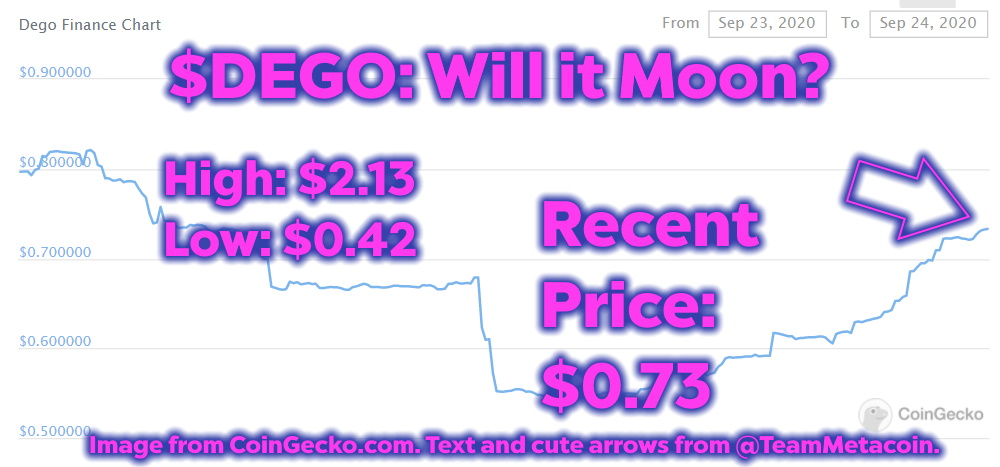
21 million tokens will be available, and, as of this writing (Sept 24, early afternoon, Central Time in the US), $DEGO was trading at 73 cents.
Right Now, It’s About Two Things…

All of these coins, tokens, platforms, and whatzits are all working on a combination of HYPE and HOPE.

Dego is trying to get the hype through a really cool UI; see the screener below and tell us it’s not just being a Windows 95 clone.

Start Me Up…

The HOPE comes from the launch of a couple things, like a liquidity pool (which is here now) and eventual Binance smart chain launch, lending and insurance.

Again, we’ll watch for more…and we encourage you to DO YOUR OWN RESEARCH. These are highly speculative investments.

OH, and here’s a CLEARLY IDENTIFIED AFFILIATE LINK: Dego Affiliate Link. Check it out for yourself and good luck!
Written by David Van de Walle · Categorized: DeFi, Dego · Tagged: Lego, NFT

Sep 23 2020

DeFi Fever: Catch It!

If you’re having a hard time keeping up with all of the DeFi (Decentralized Finance) developments, don’t fret: so are we.

Seriously: we saw a thing on Telegram inviting us to join Pancake and we, too, were wondering WHY DO THEY ALL HAVE TO BE ABOUT FOOD!

Alas and alack, here are three more DeFi platforms to consider; though one isn’t about food and, to readers of this space, won’t be a complete mystery.

REMINDER: Do your own research. We’re not responsible for your success or failure. We hope you get rich and make mad bank, but you could also get rekt. Seriously, study this stuff closely — and be prepared to lose your entire investment.

Pickle: Does It Do Anything Interesting?

Pickle announced its intentions in a Sept. 10 post on Medium: “to bring stablecoins closer to their pegs using farming incentives, vaults, and governance.”

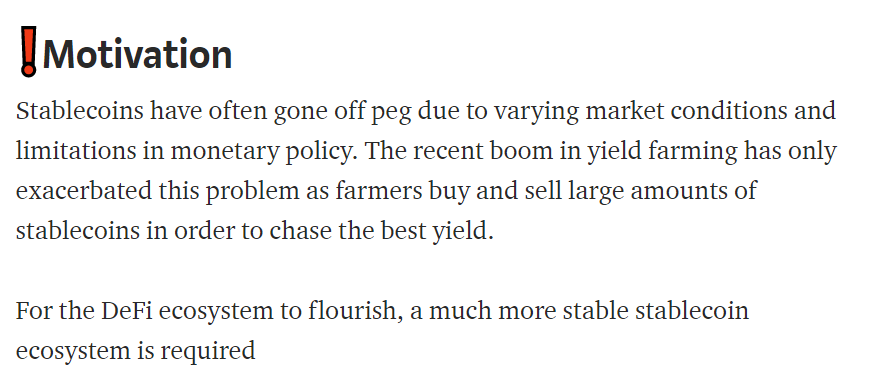
About that “off peg bad” stuff, here, from the Medium post, is the team’s motivation:

So there you have it…stability! A more stable stablecoin for a better world!

Or something like that…with the volatility in the first eleven days, it may take some time for the “peg” to be, well, pegged.

Buy low, sell high. Right?

Watch this space for more developments; we haven’t invested in $PICKLE yet, but some of our DeFi “degenerate” colleagues have.

How About Pancakes?

This one comes with a couple asterisks: $CAKE is too new to rank on CoinGecko yet and it’s also on the Binance platform. The latter means that we can’t experiment with it yet at HQ because we don’t have any assets on the Binance platform.

ALSO…

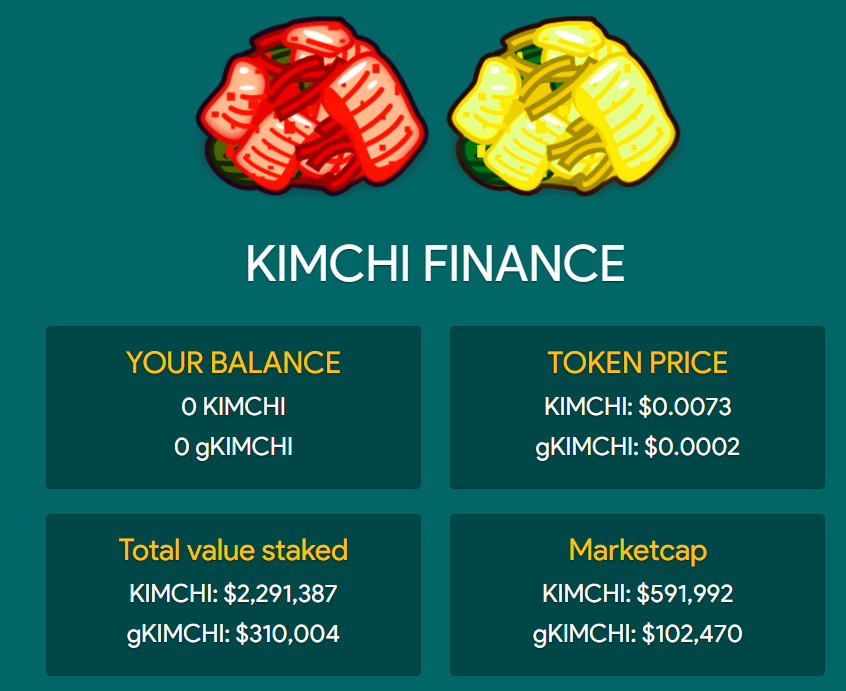
Similar to Sushi, Kimchi…

In addition to wondering why these all look the same, this one doesn’t inspire a ton of confidence yet:

Once they get the “test” off of the site, we’ll let you know what we learn.

Biggest Non-Food DeFi Development: MCP3D’s $MEGA

This probably deserves its own blog post; but we wanted to make sure this got out before what could become a feeding frenzy.

MegaCryptoPolis Bank

MegaCryptoPolis, MCP3D for short, is a gaming platform that’s like the Sims. We have written about it a few times in the past; and in this post we felt like we were one of the early adopters on the cusp of something that was about to become huge. Well, the economy within MCP3D lets you use resources to build things, and you can create those resources by actions of your citizens (say, getting one of them to run a power plant).

That economy will soon — as early as tomorrow — let you trade these resources, put them into a vault, and collect the $MEGA token. You can read about these developments in the company’s post on Medium.

We’ve been a fan of this for quite some time — there’s tremendous potential if you’re into the gamification of these crypto communities, and combining the DeFi world with the Sims-type world may be huge.

Or MEGA.

Again, watch this space for more developments and, if you’ve got something to share in this world, let us know!

As always, stay safe out there. DYOR.

Written by David Van de Walle · Categorized: DeFi, MegaCryptoPolis, Pancake, Pickle

Sep 13 2020

Three More DeFi Experiments

After spending the better part of the past couple weeks grazing at the menu of #DeFi options — why are they all seemingly named after food? — we decided to conduct another experiment. Here’s a plus/minus analysis of three of them: $SUSHI, $SHRIMP, and $KIMCHI. Hungry for more knowledge and really stupid food puns? Time to dig in.

$SUSHI: High Potential Platform

One of the most compelling reasons to check out Sushi is its head-on challenge to Uniswap. Let’s say you’re one of the OG LPs in DeFi — “Original Gangster Liquidity Providers in Decentralized Finance” — and you want to maximize the fees you collect from providing liquidity. Uniswap had you covered until it was forked — or, more accurately, copied — and Sushi was born, but with a twist.

The folks at Decrypt explain what happened much better than I can; suffice it to say Uniswap offered few benefits other than the trading fees, so Sushi stepped in.

All this backdrop — and the back-and-forth between the creator and the community, culminating in the appearance of shady backroom deals and the payback of $14m in ETH — doesn’t impact our experiment too much, though; we’re in it for the APY and the possibility of decent passive income.

Our Experiment: A Few Hundred Bucks and a $SUSHI/ETH Pool

He looks friendly, let’s see what he’s serving…

In order to invest, we followed this process:

  • Take $ETH and go to Uniswap*
  • Find $SUSHI by adding the Sushi token on Uniswap, which we needed to do by copying and pasting the contract address; you can find it at this link: Sushi Swap Contract.
  • Swap the $ETH for $SUSHI (this is where you actually buy it) but leave enough $ETH to both pool with the Sushi AND pay for gas fees (at the time, we were paying $5 or so a transaction).
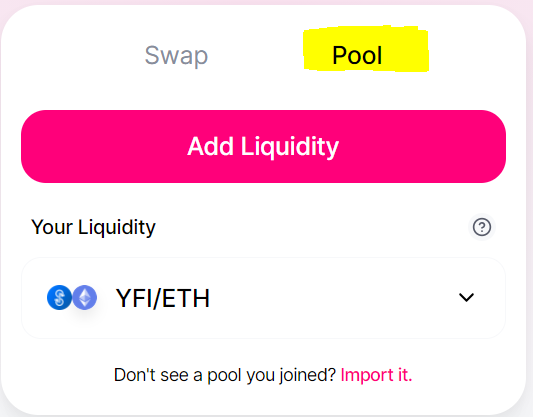
  • Now, do that “Pool Thing,” which is where you “Add Liquidity.”
Everyone Into the Pool!

* we invested using Uniswap, but now you can just go straight to Sushiswap.org and click on the “Exchange” tab. This is what you’ll see.

Looks similar…

If you follow all of these steps, you, too, can become a Liquidity Provider.

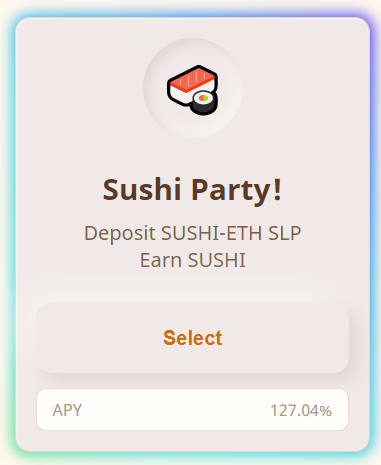
That estimated APY has come way down, actually, in the past 24 hours; we were experiencing an APY that was around 1000% up until yesterday. Here’s a screenshot from just a bit ago:

Still impressive…

We’ll continue to watch this one; the fact that the interest thrown off so far by our holdings, in the first week, added around 8% to the value of our LP tokens is nothing to sneeze at.

So Then We Got Hungry for $SHRIMP

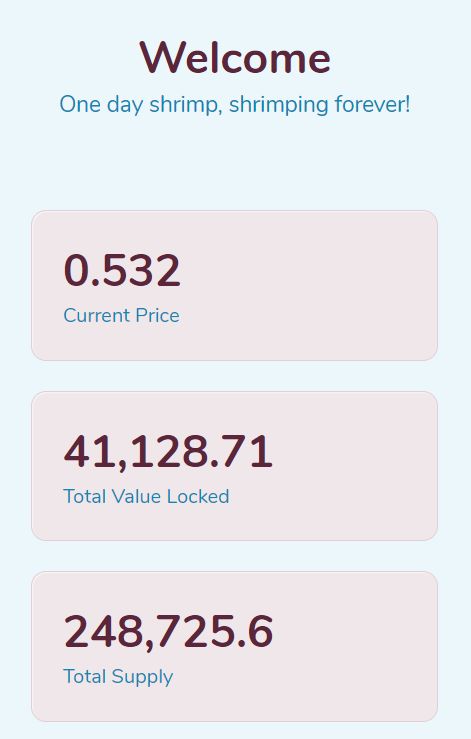
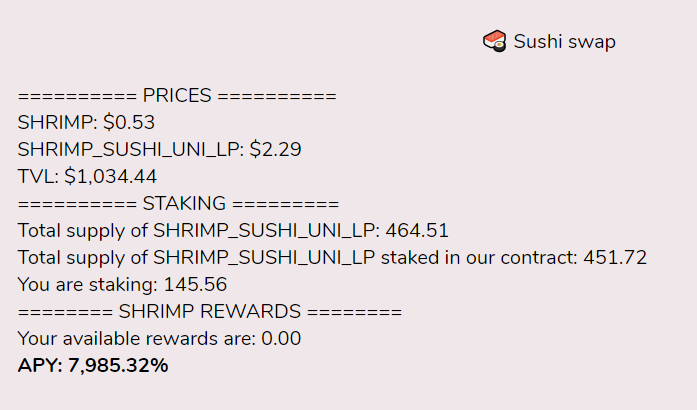
Price crazy, TVL low, supply not huge…

This one, Shrimp.finance, deserves a warning label: Votalite as Heck. You could lose everything. AND, because we still haven’t figured it out completely, it is VERY SLOW to tell you if you’ve actually gained anything.

To wit, we invested in this one and held for about 24 hours before we tried to “harvest” our earnings. When we went to harvest, nothing was there beyond our original investment.

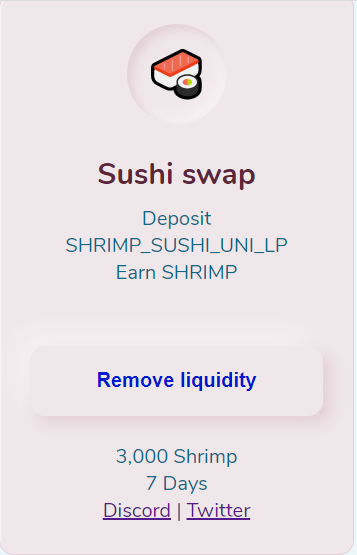
Our investment, however, is part of one of the “Advanced Pools,” screenshot below, and we believe that might mean that our investment needs to be held for 7 days before we see what our APY actually turned out to be.

Advanced Pool, DYOR, YMMV

Time to talk about math, too; or, time to talk about our understanding of the math involved. For instance, when we first saw this pool, the APY was estimated to be something like 300,000%. We think this was calculated by figuring out that the TVL in this pool was de minimis and the 3000 Shrimp thrown off to one user would amount to 821% interest per day (or 300,000 divided by 365).

When we got in, the interest level immediately dropped — though it was still a tidy 25,000%.

Spicy Meatball.

Math tells me that was on track to earn 71% a day, until someone else jumped into the pool…

Still spicy.

It has dropped to 21% or so per day — two days after we jumped back in, so we’ll play a wait and see approach and find out when and if we’ll get the interest added, and, if our math is semi-correct, how we’ll benefit. (71 percent added each of the first two days, then 21 percent added for the next few days; we’ve promised ourselves to wait until the 18th, when it has been a week, to see how interest is credited.)

Note that the volatility also calls into question just how much money this will add up to: when Shrimp launched, on Sept. 4, its price was reported at $2.65. Its own website gives the price as of this writing at $0.516, while CoinMarketCap says it’s more like 79 cents per.

As they say, “watch this space for more.”

If You’re Really Hungry, Add $KIMCHI to Your Meal

Still Hungry?

Kimchi has the potential to be quite lucrative for us; it also has the potential to blow up completely in our faces. Time for this reminder to “DO YOUR OWN RESEARCH” and not to use any of this as investment advice.

We got into this one in part because we just needed to add one additional token to our repertoire: $KIMCHI. We could have gone with one of the other liquidity pools on the page, but, in this case, all we had to do was follow similar instructions above and use some $ETH we found under the couch cushions.

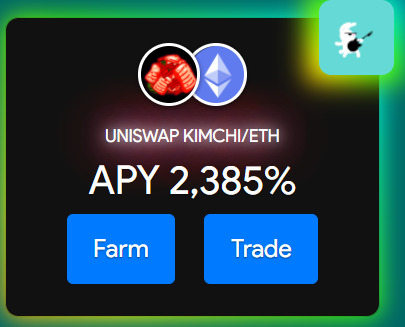
Here’s this morning’s interest rate:

Over a year, 23x your original investment.

After we bought the $KIMCHI and pooled it with our $ETH (on Uniswap; remains to be seen if they’ll add other platforms, especially with Sushi’s developments this past week), we ended up with around $520 worth of investment in the pool. (NOTE: Gas was expensive when we first tried this, and, even at $5 per transaction, you want to maximize how much you invest and minimize withdrawals.) Here’s what our stake looks like now.

About that “Kimchi Claim…”

Is it possible that we’ve already made around 6% interest on our original investment? Yes, it is entirely possible.

It’s also possible, given the low-ish “TVL” on the platform, and the sub-7-figure value of the coin itself, that this thing will continue to languish for the foreseeable future.

Or it could pop. What should the market capitalization be in relation to the total value locked? If you take $YFI as an example, the token’s market cap is north of $1 billion, but the TVL as reported by DeFi Pulse is below that. Even at a 1/1 ratio, you’re looking at a 3x growth from here in the coin’s price.

Let’s Watch This Unfold…

We’re probably best described as anxious when it comes to these platforms. Not sure what to expect, and, again, it’s an experiment. Could end up being a delicious meal, or we could have indigestion. Or worse.

Written by David Van de Walle · Categorized: DeFi, Kimchi, Shrimp, Sushi · Tagged: apy, food tokens, high interest, high risk

Aug 29 2020

When You Realize You Should Have Bought More

Every time you check the price of yearn.finance, or $YFI, it seems to be markedly higher. Here’s a price from yesterday.

An August 28 snapshot

Then here’s a price from earlier this morning.

8:23 a.m. CDT

Later on…

10:28 to be exact…

Just a few minutes later…

8…minutes…later…

What in the world?

We’d Like to Say We Called It…

When we talked about the growth of the #DeFi space recently, we pinpointed three platforms that we think showed promise. Meta ($MTA) and Curve ($CRV) were the other two, and we locked in on those and plan on “setting it and forgetting it.” (Neither of those, we think, will see the type of exponential growth that has been shown by $YFI; supply may keep both of those coins from going crazy.)

(Here’s another screenshot, from 10:45 a.m.:)

Stop the madness…

Our reasoning for buying YFI was that it was being used to “lock in” assets, coupled with other coins — a cornucopia of options, it seems — to maximize yield. Token holders are rewarded with a share of the trading fees that is proportional to their holdings.

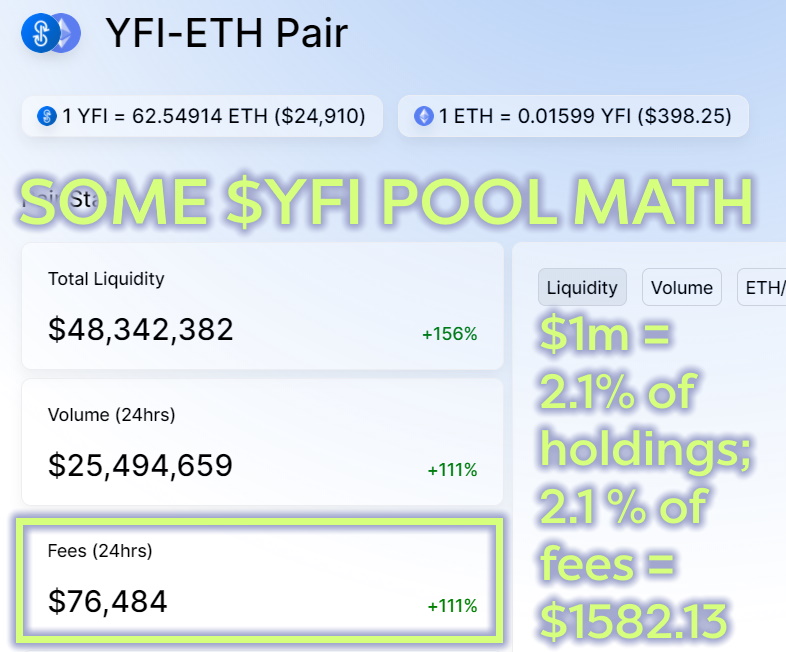
Let’s take a screenshot, do some math, and tease this out…

That’s a daily figure; whether the average fees are like today’s fees is a BIG question. Still…

The fees — 0.3% of each transaction — appear to be somewhere around half of that figure on an average day. But our $1 million example would get its share based on its percentage of the liquidity provided, so numbers could actually be higher on an average day. (August 17, very quick scan, tells us that liquidity was only $6 million or so that day, so a $1 million stake would have netted $5934 in transaction fees.)

WHAT?

No Matter How You Slice It…

We posited a guess recently that the value of this platform, based entirely on a calculation of 30,000 tokens divided into $1 billion market cap, was $33,333 each.

Turns out, if the platform keeps getting used to trade with these insane volume levels, we may have to revise that upward.

Reminder: Do Your Own Research. Not investment advice. We’re not responsible for you gains or losses. We hope you have plenty of gains.

If you need to get started in crypto, visit this link to Coinbase and, if you make a qualifying purchase, we’ll both get a bonus. Enjoy.

Written by David Van de Walle · Categorized: DeFi, Yearn Finance · Tagged: growth, on fire, yfi

Aug 23 2020

Should You Invest In Something You Don’t Understand?

There used to be an adage in finance and investments that you’re best investing in those things you understand. This is why, as the (possibly apocryphal) story goes, Warren Buffett bought Dairy Queen: he understood ice cream and the franchise model, and “got” the concept immediately.

Warren Buffett is also old.

These days, the markets are dominated by Robinhood investors, by youngsters with a dollar and a dream, and by speculators hoping that Hertz will go up from pennies to dollars simply because pennies are cheap and dollars aren’t.

The Market #DeFi -es Logic

That’s deliberate, what we did with the subhead: logic is possibly defied by the decentralized finance market, colloquially known as #DeFi. Decentralized platforms — coins? tokens? businesses? not sure WHAT to technically call them — have entered the market and gone from zero to OMG in a few short months; one of these #Defi #Darlings (yearn.finance, or $YFI) has rocketed from 800 bucks to $13,000 in four weeks.

DAI token earning 50% interest
Is this an actual interest rate?

The screenshot above is from the Yearn website, and, specifically, the “Vault” tool on the page, where you can upload you coins — above is a DAI Stablecoin — and leave them there and make 50% interest. Right?

As we told you a couple weeks back — here’s the post on the Liquidity Machines Going BRRRRR — we were brand new to the concept of “yield farming,” and “liquidity machines,” and “stablecoin lending,” and interest rates that are straight up fire.

We had a couple ideas in a subsequent post (The Oldsmobile of the Crypto Market) for platforms that *could* catch fire; but, in the same breath where we told you to “do your own research,” we were doing our own research.

And we’re still not sure how it all works.

Curve Liquidity Provider token earning 97% interest
Only 97 percent?!?

However, we have picked up a couple of things — and we thank a couple of power-DeFi users, who we’ll talk about later — so we thought we’d share some of the knowledge here.

First, Think About Your Bank

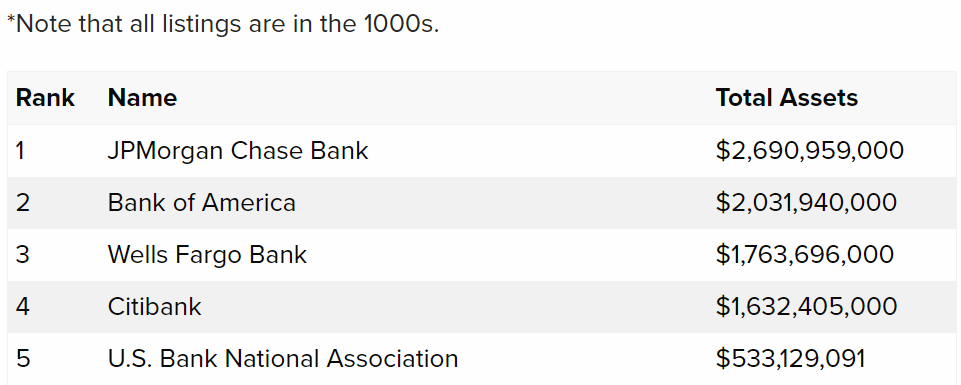
It’s actually quite fun to think about this Defi space as the equivalent to a bank: if you want to break into the top tier of banking in the US, you need to have trillions of dollars in assets. Like this, from a chart from MX.com, showing the top 5 banks.

Top banks by total assets.
You probably bank at one of these institutions, America.

Obviously, this counts your money and my money and everybody else’s money in this list; lots of deposits, lots of withdrawals, and maybe a few mortgages and certificates of deposit and car loans and…the list goes on.

The banks above make their money from interchange fees — the tiny percentages charged for transactions — or from banking fees — gee, why does my bank charge me $5 monthly just to keep my money there? — or from the margin spread between what they lend at and what they pay in interest.

(A truism from community banking way back when was the “3/6/3 Rule:” Pay 3% in interest on savings, charge 6% in interest on loans, and be on the golf course by 3:00.)

These days, you need a lot of money in your vaults — I mean on a ledger somewhere, because it’s all a line entry on a computer spreadsheet — to really make it as a bank.

So, if we want to compare banking to Defi, how do we do it? Probably with a metric called “TVL,” or “Total Value Locked.”

We’re Just Getting Started

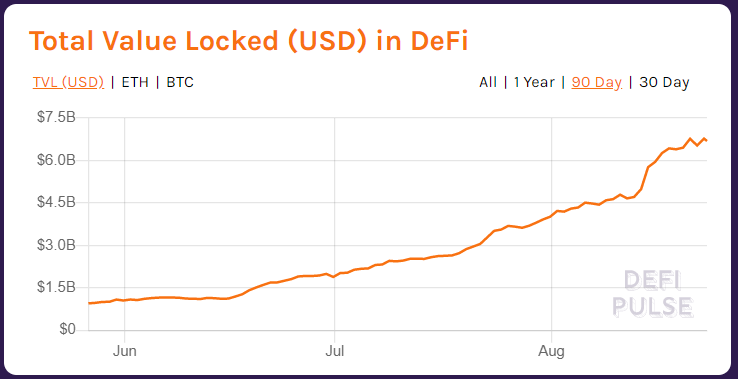
The website Defipulse.com has a great chart of where the industry stands when it comes to how much value is locked up in these decentralized finance platforms. Hint: It’s the top of the first inning and the pitcher hasn’t even faced the leadoff hitter yet.

Close to a 10x in 90 days.

Locked and Loaded?

Hardly enough is locked to even be ready to begin to just start to think about scratching the surface: $6 billion is nothing to the big boys or even the not-so-big boys. So it’s still really early.

Again, this is not financial advice, do your own research, and don’t invest more than you can afford to lose; but if you’re ready to start learning, we highly recommend resources from a chap called “Defi Dad.” One of his videos, on the site “Bankless,” is below.

Top of the First…Who’s the Leadoff Hitter?

If we’re just getting started and we think about this as the top of the 1st inning in a nine-inning game — and we think about DeFi as the visiting team playing against the Big Banks — we need a leadoff hitter. We need our Rickey Henderson.

For the uninitiated, Rickey Henderson was a baseball Hall of Famer who led off the first inning for his team by hitting a home run 81 times. Second-best on the list, Alfonso Soriano, did it 54 times.

(Dexter Fowler led off the top of the first with a home run in Game 7 of the 2016 World Series for the Cubs, but I digress.)

Had to share…

Anyway, if we’re going with our Rickey Henderson in this space, it has to be $YFI.

TVL $1,040,341,676https://t.co/JiHslRvOmq pic.twitter.com/SoZfX2GT8T

— yearn (@yearnfi) August 22, 2020
Positive development for $YFI.

If you want to learn more about Yearn.finance, we suggest checking out this site: learnyearn.finance. They’re bullish as heck about the coin itself, and — while encouraging you (like we will) to “do your own research” — they make the case that the price of $YFI is possibly way undervalued.

The Flippening (Kinda) and Warren Buffett

Hey, let’s get back to Warren for a hot second as we wind up this post. One share of Buffett’s Berkshire Hathaway is $311,000. He hasn’t split the stock and doesn’t plan on splitting the stock.

Earlier this week, the price of $YFI exceeded the price of $BTC; while it’s not a “flippening” in that the market cap of YFI is dwarfed by the market cap of BTC, it’s still a psychological victory.

And, with the total number of YFI tokens capped at 30,000, with no more ever to be minted and 99.87 percent of the tokens circulating, if Yearn’s market cap were to get to 1 billion, that implies a price of $33,333.33 per token.

Bullish Case

If you aren’t convinced that we’re early in Defi, we suggest you check out the resources we’ve listed, do your own research, and strap yourself in.

In any event, DeFi is just getting started.

Speaking of getting started…

Here are a couple CLEARLY MARKED AFFILIATE LINKS, in case you want to buy a little of crypto to get into the game:

Crypto.com has a good chunk of the coins and you can tie them to their debit cards, which are pretty nifty;

And Coinbase.com will also get you started and is simple to use.

Both give bonuses to us with qualifying crypto purchases, and those bonuses help us keep the lights on, so to speak.

Written by David Van de Walle · Categorized: Curve, Yearn Finance · Tagged: DeFi, Leadoff Homer, Rickey Henderson, Top of the First

  • « Go to Previous Page
  • Page 1
  • Interim pages omitted …
  • Page 8
  • Page 9
  • Page 10
  • Page 11
  • Page 12
  • Interim pages omitted …
  • Page 37
  • Go to Next Page »

Copyright © 2026 · Altitude Pro on Genesis Framework · WordPress · Log in