• Skip to main content

Metacoin

Covering Bitcoin, the Blockchain, Altcoins, and Fintech

  • Start Here
  • Links
  • Disclosures
  • NFTs
  • Collezione

Apr 26 2020

Checking in on the BRED Portfolio

If you want an answer to the volatility in the financial markets, is it possible that the BRED Portfolio — our 2017 combination of Bitcoin, (Ripple’s) XRP, Ethereum, and Dash — could be just the thing?

Well, maybe and maybe not. However, if you are looking for a hedge against a big chunk of other assets, maybe BRED is the answer to your questions. Let’s take a look at how it is faring in 2020, how a couple other things are faring, as well as how BRED would have fared if you had bought in 2017 and left it alone. (The Ultimate HODLer Portfolio.)

First, Here’s the 2020 BRED Portfolio This Morning
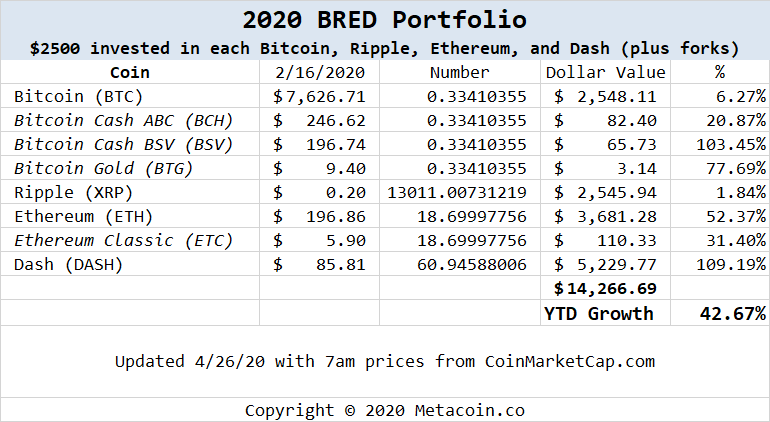
A decent return, no?

You would have a tough time to find a YTD asset class with a 42.67 percent growth so far this year. Right?

A quick Google search yields this result, where the US Long Treasury Index yields the best result. (There’s a feeble attempt at a yield pun in that sentence, since it’s an index that tracks the yield of US Treasurys.) 20-plus percent for that one.

From Vanguard.com

What about precious metals? Didn’t they do okay?

Answer? No.

Remind me to further study the palladium market later.

TL;DR — Bitcoin and its Ilk Win So Far in 2020

Whether or not it’s the ultimate Ron Popeil portfolio — “Set It and Forget It” — remains to be seen. But you could have done a heck of a lot worse with other assets in 2020.

Which lead us to the question about the OGs, the ones who have HODLed their BTC (and ETH, XRP, and DASH) and are just kicking back. How would they have done?

Wow…
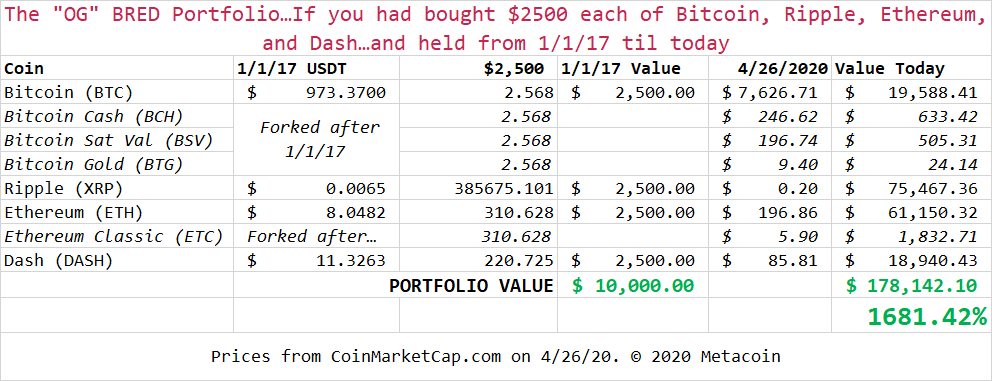
This is a 16-bagger.

Well this is something to behold. (Not that you can find anyone who bought Bitcoin in early 2017 AND held it AND isn’t a public Bitcoin bull AND would actually tell you that they’ve bought and held.)

So there you have it…if you’re not a day trader and maybe an investor and have some cash to set aside, a portfolio that you pretty much ignore might do the trick.

Of course, we should tell you that you’re on your own and we aren’t responsible for your successes or failures.

Happy investing!

Written by David Van de Walle · Categorized: Bitcoin, Dash, Ethereum, Ripple, XRP · Tagged: BRED 2020

Apr 22 2020

Learning From Negative Oil

If you think you have witnessed a once-in-a-lifetime event when you saw oil prices turn negative on Monday, you’re wrong on two fronts. Oil prices didn’t turn negative — it was the underlying WTI May Contract, with an expiration date on April 21, that turned negative — and it is not a once-in-a-lifetime event: it will happen again in another month.

Oh, and it will be worse.

If there’s something to be learned from all this — for Bitcoin enthusiasts, for the common man, and for the people with a minivan sitting in the driveway that’s full of petrol and longing for the open road — it’s that a quick study of supply, demand, derivatives, ETFs, dollar-denominated assets, your 401(k), and, of course, Bitcoin and other cryptocurrencies is in order. Let’s begin, because the ramifications are going to impact just about everything.

What Happened?

It’s actually quite simple: the oil that was ordered by holders of the WTI May contract had nowhere to go. So what started as a fire sale — hey, buy this for a few cents a barrel! — turned into a situation where contract holders were actually paying people to take the oil off their hands.

Now, before you join the cacophony of “I’ll take that oil and put it in my garage and they can pay me $37 a barrel!” cries, you have to realize a few things about these contracts:

  • Only certain types of investors can actually hold these contracts: unlike other derivatives, futures contracts like the WTI ones that went nutso aren’t open to the average investor (more on what that means for ETFs below);
  • They are actual delivery contracts, and this is why they are not open to the average investor;
  • Yes, that means that holders have to take delivery of the physical product.

Tease this out for a half second and you’ll see why this is such a quagmire: the oil had nowhere to go.

Now you can see why this market went south in a big hurry; like a game of hot potato, nobody wanted to be left holding a worthless asset. (Not a worthless derivative that gives you the right to take delivery of a stock if you want it, but an actual tanker of oil that has nowhere to go.)

But Why?

When the Coronavirus crisis started, global oil production was somewhere in the neighborhood of 100 million barrels per day. Russia and Saudi Arabia agreed to cut production by 10 million barrels a day, which helped a little when the economic shutdown started.

But, as Danny Masters from CoinShares — a former energy trader, so he knows his stuff — shared on a video yesterday, demand for gasoline (which is one of the finished products that comes from a barrel of oil) dropped 55 percent in the month of March. “A 3 million barrel drop is overly bearish” for the market, said Masters. So imagine that the oil that had been refined into gasoline got stuck; it couldn’t leave the refinery for the corner station because the corner station wasn’t selling gasoline because your minivan is sitting in the driveway. This is an order of magnitude worse: if demand is around 45 million barrels worth a day, but supply has continued apace because orders have to be filled…you’d need a cut of 55 million barrels of production a day so that the supply doesn’t completely dwarf demand.

But that cut didn’t happen.

Where Could the Oil Go?

Cushing, Oklahoma is where most of the oil in the U.S.A. gets stored. CNBC reported that, as of April 17, Cushing was 77 percent filled.

But, with the real possibility that Cushing becomes filled up — especially with deliveries slated to Cushing to satisfy May contracts AND few refineries sending tankers out with gasoline because there’s less demand for gasoline — it’s highly possible that the oil will continue to be stuck in limbo.

Reuters is reporting that Oklahoma is relaxing production rules; this will help, but won’t solve the underlying supply/demand issue. Bringing us to the June WTI contracts…

Are June Contracts Doomed?

In a word: yes.

In another few words: it’s going to get really bad again.

Tease out the above realities: Cushing was three-quarters full before all the favors were getting called in. “Can you take some oil off my hands? Can I pay you to do that? Can I pay you MORE to do that?”

While the price of the June WTI contract is hovering in the low teens right now, the guess is that no more favors will be left to call in. The Strategic Petroleum Reserves are pretty much at capacity. It will be no surprise to see the June futures turn negative again — perhaps well before the expiry date of May 19 — and, without steep cuts in drilling, this could be a monthly occurrence.

What’s the Next Domino to Fall?

USO. If you’re wondering whether or not this ETF is in trouble, consider these facts:

  • This ETF is down 80 percent this year.
  • Rules governing the fund’s investments needed to be changed as a result of the WTI May Contract Freefall. The fund was slated to invest just in the next month’s contract and attempt to replicate its gains or losses; once the WTI went negative, then dramatically so, the fear was that continuing to track against a negative balance would be untenable at best and cataclysmic in a worst-case scenario.

We’d stop short of saying this is “the perfect short,” but a crazy-volatile investment that goes negative can only lead to borderline insanity. Beyond that, with “Stay at Home” orders continuing, demand in the month of April — remember, people didn’t start facing these quarantine conditions until March 11 at the earliest — will likely fall below the demand for the month of March. The glut will not be solved without turning the oil pumps off completely. It’s a shock to the system — only the large oil companies will be able to weather the storm.

We could be wrong — the rules to change the calculation of the ETF’s investment is a good step — and the fund could bounce back. But we’d stay far away.

And…What — If ANYTHING — Does This Have to Do with Bitcoin?

Back to the Danny Masters CoinShares interview, as it uncovered a couple of interesting ideas. In part one, Masters tells host and CoinShares colleague Meltem Demirors about the underlying conditions leading to the negative oil. Demirors counters with an interesting concept:

“People thought they were buying an asset, but instead they were buying a liability.”

Metltem Demirors, CoinShares

Here’s the first part of the interview:

So if you think about Bitcoin — and other cryptos — within the concept of buying an asset vs. a liability, there is a near-zero chance that someone will ever pay you to take their BTC off of their hands. Crypto is an asset, not a liability. And the need for an asset AND a digital currency — especially in a “contactless” community that we’re all in the process of joining whether we like it or not — will only grow in the months to come.

But that’s not the most telling piece of this interview; that comes in part two, which you can watch here:

Demand for oil is low.

Demand for Bitcoin is steady; with the upcoming “halving,” when the rewards for mining a block are cut in half, fewer Bitcoins will be released into the wild. Masters, in the interview, thinks that “HODLers” (like him) won’t get rid of their BTC until it’s closer to $10,000.

And large funds lock up people’s BTC — Greyscale’s fund, for instance, has a lockup that lasts about a year — so people aren’t going anywhere anyway.

Finally, Volatility and the Brrrrrrr Factor

Oil will be volatile for sure. Bitcoin already is volatile, has been volatile for some time, and should continue its volatility for the foreseeable future. Oil traders are not used to what they’ve seen this week; Bitcoin traders yawn (and aren’t going to see negative Bitcoin ever).

But the Fed’s role in all this can’t help oil supply — only an economic rebound that gets people driving again will do that — and is more than likely to seriously help the Bitcoin market considerably. The Fed’s ability to print money and do some sort of quantitative easing at the drop of a hat can only mean that the long-term prognosis for some sort of anti-dollar is nothing but strong.

Our advice: buy whatever you can, within reason. Good luck.

IF YOU WANT to get started, you can use our AFFILIATE LINK to buy either from Coinbase or from Crypto.com. With a qualifying purchase, we can both be compensated.

Written by David Van de Walle · Categorized: Bitcoin, Economy · Tagged: brrrrrrrr, coronavirus, covid19, negative oil

Apr 16 2020

Why a V-shaped Economic Recovery Is Folly

“In these Uncertain Times” is the phrase that sets my 18-year-old daughter off in fits of eye-rolling. They aren’t fits of rage — as, let’s be honest, when you’re 18 and a college Freshman, your rage is aimed at other things — but genuine reenactments of the Michael Jordan “Stop it” meme.

Everyone has gotten into the “In these Uncertain Times” act. Jan from Toyota — appearing in ads festooned as Jan from Toyota, but, of course, from what might be her home office — tells us that Toyota is there for us. Because auto makers and car dealers are the first thing we think of when we enter a global pandemic.

Jan from Toyota is joined In These Uncertain Times by a newly branded “The More You Know” series from the networks of NBCUniversal. Hey, we don’t know what we’re getting into either, but you should know that we’re here for you. In these Uncertain Times.

In any event, the eye-rolling is warranted. It’s not a specific “stop the spread” or “flatten the curve” catchphrase; those ask for a little bit of explanation about why they are important platitudes. How, exactly, do we “stop the spread?” What, exactly, is this “curve” that we must, together, “flatten?”

We want our mantras to be non-specific and our buzz phrases to be amorphous. “In these Uncertain Times” works. Because nobody knows what the hell will happen next. Thus the eye-rolling.

An Uncertain Recovery

If you’re new to this site, we mostly cover cryptocurrencies like Bitcoin and how and if they’re weaving their way into modern life. But, as we’ve discussed in the past…well…In these Uncertain Times, Bitcoin doesn’t have a decades-old history to point to. There are no parallels to the Great Ethereum Bounce of 1976, or the Binance Bottom of 2003.

Which brings us to the overall topic of this article — whether or not anyone knows what in Sam Hill will happen to the economy when and if there’s a magic switch that gets flipped and everyone goes back to work.

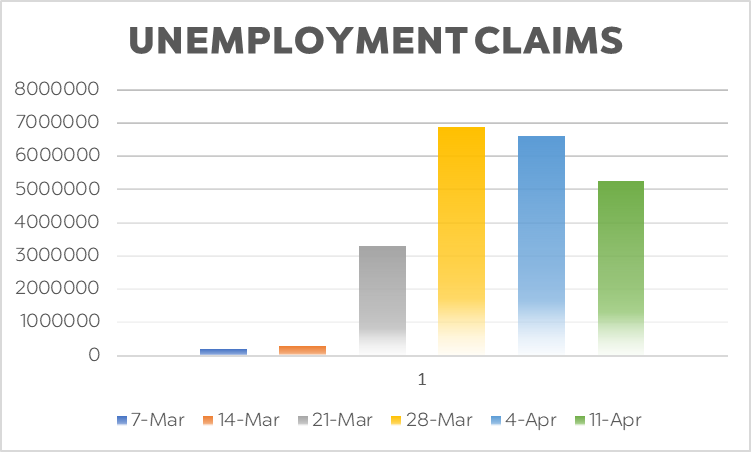
May I Interest You in Another Unemployment Chart?

Those six data points above need no explanation. To say they suck is putting it mildly; the wind came out of the economic sails on March 11, and we are not going back any time soon.

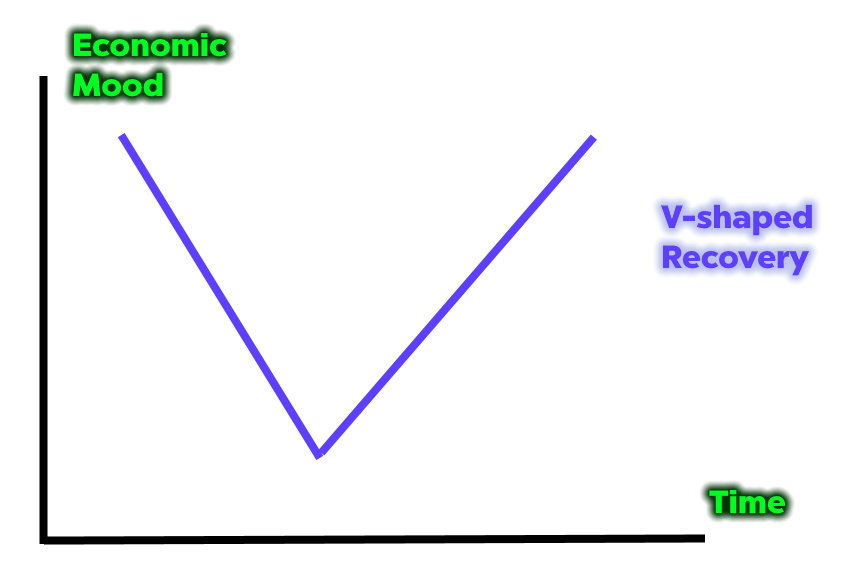
The “V-shaped recovery” crowd doesn’t necessarily think there will be an immediate switch-flipping exercise, but they do think that the “Trough of Suck” will be rather short-lived. (More on the Trough of Suck below.)

An overly simplified version of what the V-shaped folks think will happen is here:

Quick bounce back to decent mood?

The assumptions within a V-shaped recovery are too numerous — like dropping a quarter from space and trying to hit a shot glass in a field in Texas — but here’s a quick synopsis of how that could work:

  • A “back-to-work” order arrives from the Federal government and is adopted over the course of a few weeks by at least a vast majority of the states.
  • COVID-19 cases have reached their peak, and we have flattened the curve.
  • Restaurants open back up with a social distancing guideline of some sort.
  • You can get your hair cut and your nails done and get a facial — provided that the provider of these services has been cleared by a doctor to provide these services, and provided that a mask is worn.
  • Your kids go back to some semblance of in-person school.
  • You can host a dinner party at your home with more than just your immediate family.
  • No one in your immediate family is sick.
  • You have contact tracing in place so that you can prove that this morning’s trip to the pharmacy did not expose you to the virus.
  • You have an employer that is willing to bring you back to work, hasn’t laid you off, hasn’t gone out of business, and has received a Paycheck Protection Program loan from the SBA.

Actual Recovery Looks Much Different

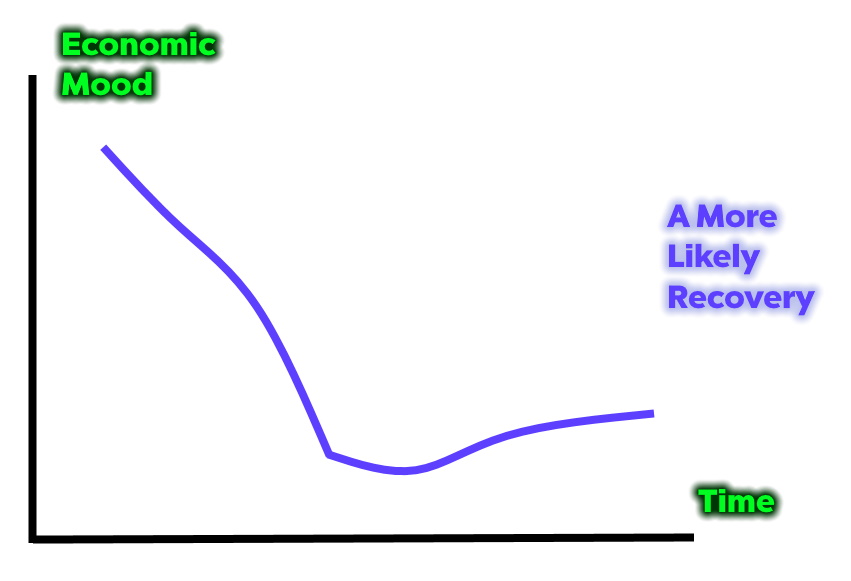
What we’re actually going to see…

If you take a look at the blue line up there, it’s sorta kinda meandering downward, and then comes up a little bit — THE NEW NORMAL — and then we all figure out how to manage. Which is much more likely.

Trough of Disillusionment Vs. Trough of Suck

Gartner has a concept called “Trough of Disillusionment.” I’ll let you Google that — type in “Hype Cycle” and learn more about how analysts think about the launch of tech products — but I’ve decided to apply that thinking to something I’m calling the “Trough of Suck.”

In short, the V-shaped crowd may say “it’s going to suck for a little while” and then they think that the switch magically flips and we’re back to where we were before.

There’s also a “U-shaped Recovery” crowd, and they think there will be a bit of an extended period of pain and then gradually things come back.

But neither of these buts “The New Normal” up against the stark realities of that unemployment chart above and gets a real, actual, “Trough of Suck.”

Expect this to last a long time…

What we’ve done over the past six weeks is unprecedented — and, dare we dip our toes into the “do you want to save your Grandma or do you want to go back to work?” argument, we’re about to enter into a Trough of Suck phase that will last for YEARS.

Take a look at this jobless claims article from Yahoo: we’ve sent 22 million people into the unemployment lines. How many of those will be able to go straight back to work?

What’s Next?

Allow me, your fearless prognosticator, to hazard a few guesses about what’s next as it pertains to you and your own microeconomy.

1. Since it’s NOT an either-or, people HAVE to go to work.

Though this danse macabre will continue, the list of essential services will expand. Because it has to — yesterday’s Michigand Yeet Fest was evidence that the Governor has overstepped her bounds by at least an order of magnitude and the seeds of discontent were long-since sown.

2. But some of you — some of us — will be stuck.

I was deemed non-essential ages ago and Lord knows I’m going to be doing a metric crapton of soul-searching about what I get to do next. (I can write about Bitcoin until the cows come home; eventually, I may have to learn how to milk said cows. Writers are non-essential — this runs counter to what the talking heads will tell you about how important the arts are In These Uncertain Times — but if I write content and that content doesn’t actually move the needle they’ve been talking about for years (in no small part because you can’t move any needles if those needles are tied to dollars an no one has either needles OR dollars), I’m going to have to find actual gainful employ.)

3. Plan for a long haul — without any idea how long that haul will be.

We’re not just trying to put the toothpaste back in the tube; we’ve asked everyone to brush and spit out and don’t swallow the toothpaste AND we’re trying to put that back in the tube.

Price of Bitcoin? Price of gold? Price of eggs, value of dollars in RMB, cost of goods sold…your guess is as good as mine as to what will happen to ANY of those things.

It’s Not a Binary Question

I’ve dumped a lot at you in this article; thanks for reading so far. If I’ve got an ask, it’s that we stop looking at this as a binary question.

The President was actually right when he talked about the human cost of shutting down the economy. Lives will be lost to the virus — but will more lives be lost to those “deaths of dispair” that people really don’t want to talk about?

The President likes to give the impression that he has a magic on/off switch for the economy; Congress likes to think that its Herculean efforts to get the CARES Act signed into law supplied the direct current for that on/off switch.

The reality — with the “will the recovery be ‘V-shaped'” and the “when can I go back to work?” and the “is it safe enough to be out in public?” crowds — is that these arguments are much more nuanced. The give-and-take that’s playing out in public is not as simple as “go back to work and Grandma dies.”

Stop playing that game. Please.

And pray for a shorter duration of the Trough of Suck.

Written by David Van de Walle · Categorized: Economy, Uncategorized · Tagged: Bitcoin, Trough of Suck

Apr 02 2020

“We Should Have Doubles Within Six Months” — Novogratz

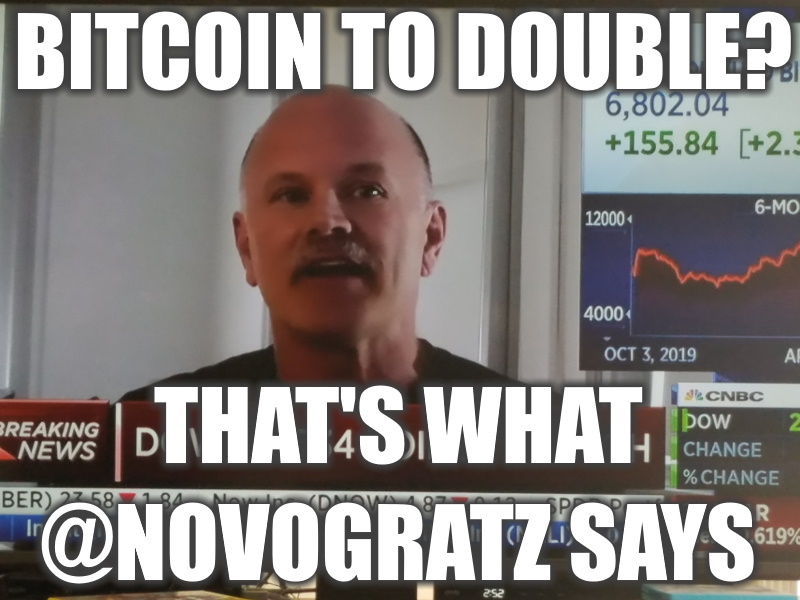
“If it doesn’t go up now, I’m not sure when it will.” Those were the words of Galaxy Digital founder and Bitcoin bull Michael Novogratz, who appeared earlier today (April 2, 2020) on CNBC.

He teased the interview on Twitter (see below) and he didn’t disappoint.

3:35 talking $btc, markets, and testing. @CNBC pic.twitter.com/l5aeOThxsp

— Mike Novogratz (@novogratz) April 2, 2020

After talking about the feeling that “we’ve crossed a Rubicon and people think money grows on trees,” then saying we’ve “debased fiat,” co-host Wilfred Frost asked Novogratz to pick a number.

“We should have doubles within six months. We really should have…Maybe, (by the) end of the year, retesting the old highs.”

But…Wait a Minute…

Co-host Sara Eisen was taken aback by these comments, challenging Novogratz. “Mike, the problem with your theory — sorry to cut you off — is everyone wants dollars now…Dollars are still in demand and are valuable.”

Novogratz countered by saying “that’s always the first reaction…then all of a sudden, people are saying, ‘what did they do with the dollar?'”

Novogratz also asked whether or not the next stimulus package will lead to more questions about the dollar — and whether trillions more will negatively impact the dollar against Bitcoin.

Bullish Is He

Not a bad time to get into the market, maybe, with the price of Bitcoin today jumping 7-plus percent.

If you want to get some, you can use our AFFILIATE LINK here for Coinbase or Crypto.com.

Written by David Van de Walle · Categorized: Bitcoin

Mar 27 2020

3 Coins You Can Buy on Crypto.com

Following a little on the theme from a couple days back — and you can see it here where we talk about the investor dude’s 5 Coins to 5 Million project — we’ve decided to start analyzing coins you can actually purchase (if you’re an American) on Crypto.com. (THAT IS AN AFFILIATE LINK; we may be compensated if you open up an account there.)

A couple reasons for going this route:

  1. If you’re new to crypto — as many are — you might not be ready to go through a laundry list of steps to access the coins that *could* pop;
  2. You’re not getting into this to “flip” coins or day trade (95% of the visitors to THIS SITE, at least, are ones who are less interested in trying to get in and out of coins and more interested in long-term strategies like the ones you can read in last year’s popular post: Playing the Long Game);
  3. You DON’T WANT TO MESS WITH THE LAW.

That third piece is really important: you do not want to get into the business of investing in a foreign-domiciled altcoin that could be hunted down by the US SEC. You want to use companies that have been blessed in the US and have projects in their platforms that are okay with American regulators.

Only two ways to do this: Crypto.com (AFFILIATE LINK AGAIN) and Coinbase (ALSO AN AFFILIATE LINK).

We’ve decided to study this in a few parts; today, we present a deeper dive into three of the coins that you could, conceivably, buy right now.

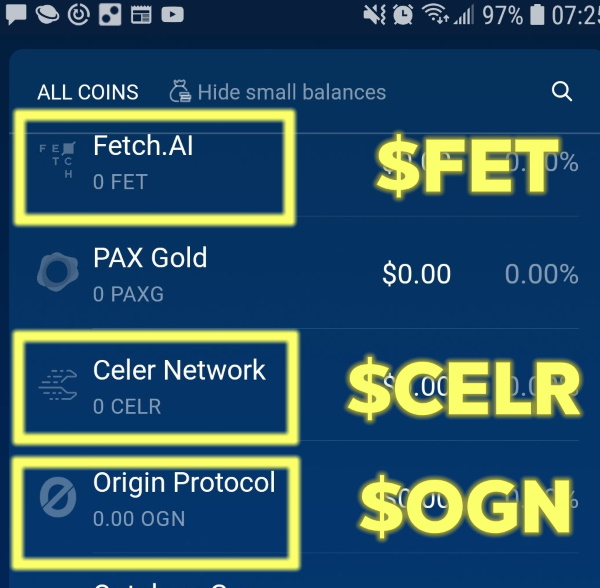
1. Fetch — $FET — Possible Low Market Cap Gem

Fetch sounds really compelling, especially in light of everything that is happening in the world. One of the use cases is the type of thing that we’ll hear about as manufacturing either shifts toward making ventilators, or ramps back up when the auto and aircraft manufacturers start making their products again:

In the video (which you can watch below) the CEO talks about a consortium of steel mills that are already using the platform. More discussion is on the “Use Case” page of the Fetch website.

Fetch CEO Humayun Sheikh

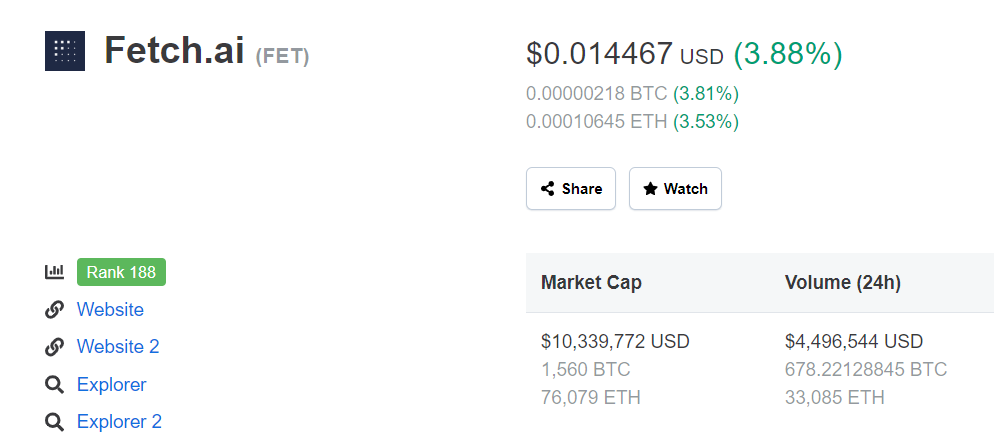
The market stats for Fetch are definitely in line with what the 5-coin guru says: low market cap, really good use case, could take off.

Potential “unicorn?”

Tease this out as a potential unicorn for a second: if its market cap goes from here to $1B, that is a possible 96x from here. AGAIN, DO YOUR OWN RESEARCH.

2. Celer Network — $CELR — eSports Platform on a Blockchain

Actually, that subhead to describe Celer probably could be a cocktail napkin pitch. “Hey, let’s power eSports, but do it on a blockchain!”

If eSports turns into a larger industry than it currently is — and, in 2020, with people not leaving their homes, the odds are it very well might do just that — CELR is on the cusp of something huge.

Applying the stupid-simple “Potential Unicorn Math Process” (also known as “PUMP” because you need to be wary that any of these could explode AND then dump just as quickly), you could potentially go 169x with your money.

(Also time for us to repost our DYOR sign: Do Your Own Research.)

3. Origin Protocol — $OGN — “The Blockchain Platform for Building Decentralized Marketplaces”

If the future will be decentralized, a bet on Origin could turn out to be a smart one.

Screengrab from Origin website

Origin is betting that (1) people will start (or continue) hating on existing peer-to-peer platforms like Uber and Airbnb and (2) the growth of peer-to-peer marketplaces will be decentralized.

This looks like it could be a really wise bet.

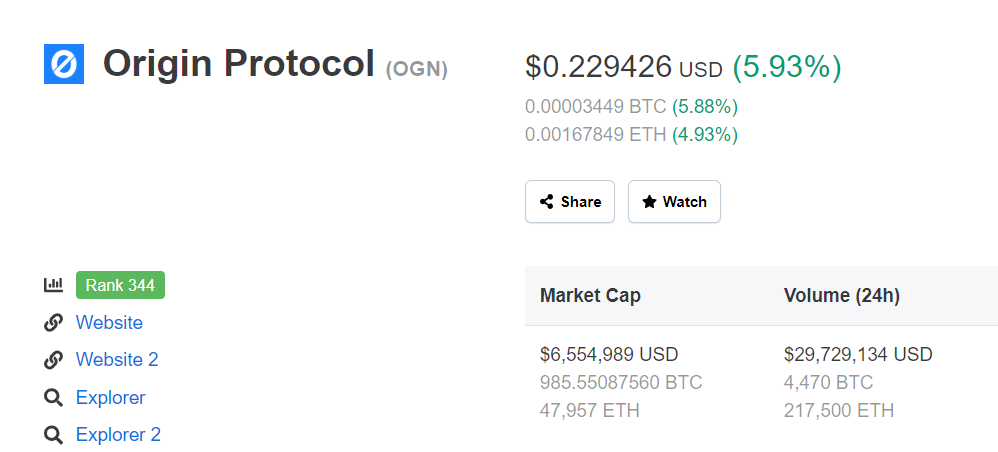
Using the PUMP metric, you could go 155x your money if this project goes Unicorn from here.

More Caveats

We’re not telling you to run out and spend hard-earned cash on these projects. You need to Do Your Own Research (there’s that acronym again) and don’t get in over your head.

But, to the extent that you want to take a chance on a coin that could pop, or you have extra cash sitting in a drawer that could be put to use, an investment in any one of these could — again COULD — potentially pay off.

Good luck.

Written by David Van de Walle · Categorized: Celer, Crypto.com, Fetch, Origin · Tagged: 3 coins, 5 coins, big t, dyor

  • « Go to Previous Page
  • Page 1
  • Interim pages omitted …
  • Page 10
  • Page 11
  • Page 12
  • Page 13
  • Page 14
  • Interim pages omitted …
  • Page 37
  • Go to Next Page »

Copyright © 2026 · Altitude Pro on Genesis Framework · WordPress · Log in