• Skip to main content

Metacoin

Covering Bitcoin, the Blockchain, Altcoins, and Fintech

  • Start Here
  • Links
  • Disclosures
  • NFTs
  • Collezione

David Van de Walle

Apr 07 2017

Quadruple Your Money with the BRED Portfolio

When we stumbled upon this idea this morning, our first instinct was to play it rather cool with the headline. Something like “Introducing the BRED Portfolio: A Buy-and-Hold Bitcoin and Altcoin Investment Strategy.” And that sounds very straightforward, by the book. It’s also boring.

So we went with the clickbait headline.
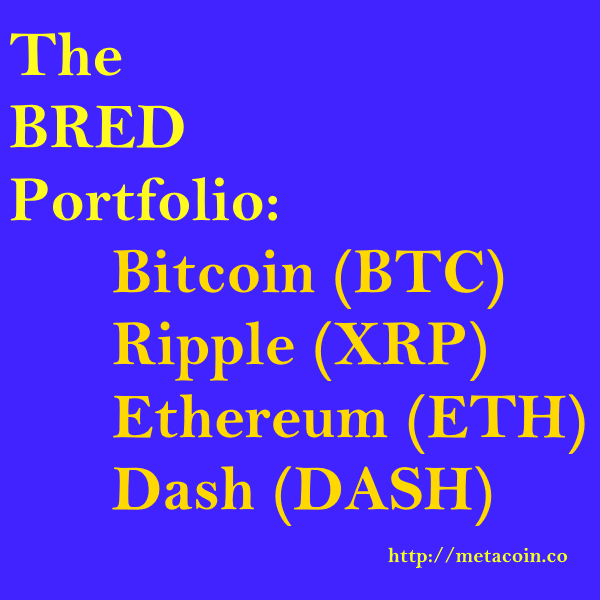
Read on:

Why “BRED”?

There are a couple reasons behind this one – and it’s not just because these four letters fit together nicely. (They do, though. Props to us.)

Think about one of the best business and investment acronyms out there: FANG. Jim Cramer claims to have created the acronym several years ago, used to put four “new economy” stocks into one nice bucket. Facebook. Amazon. Netflix. Google.

It’s easy to remember, but it also includes four really solid tech stocks – and four companies that are, you could argue, doing quite a bit differently while still being in the same category.

We thought the same thing when creating this portfolio strategy: let’s get four of the biggest cryptocurrencies out there and put them in one bucket.

BUT, let’s do this with an eye toward the ones that have the best chance of long-term staying power.

While “BRED” works nicely as an acronym, these are also four coins that have managed to stick around in the crypto space.

We’re not just rationalizing…

B is for Bitcoin, and you couldn’t have a portfolio like this without Bitcoin, since it started this whole shebang, right?

R is for Ripple – which, for some reason, doesn’t have a ticker symbol that starts with “R” – and Ripple’s USDT price developments of late don’t tell the whole story; consider it the best chance of becoming the backbone of all crypto transactions throughout the world.

E is for Ethereum, whose “smart contracts” were, you could argue, the first yin to Bitcoin’s yang.

D is for Dash – “digital cash” is a very easy and consumer-friendly value proposition. We will argue that this one could win out based on the strength of its community alone.


Look at the rankings, though – if you visit Smith and Crown this morning, you’ll see that these are four of the five largest cryptocurrencies – in terms of market capitalization – in the world. In fact, going back to January 1, you would still have been picking four of the 7 largest cryptos, as shown in this chart from CoinMarketCap.com.

Argue with us if you’d like, but we’re going with this acronym. You’ll see why in a second.

Structuring the BRED Portfolio

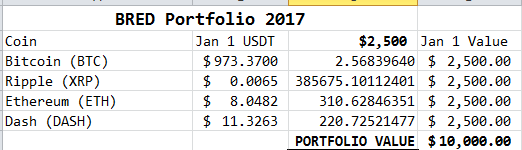
To keep it simple, we used January 1, 2017 as our starting point. And, as opposed to weighting the portfolio by market cap – which would have had Bitcoin at about 92% of the portfolio, defeating the purpose – we went with a straight 25% invested in each.
Bred Jan 1

To get the prices, we grabbed a chart from TradingView.com – our first-ever visit to the site, which is bloody easy to use, we might add – and use their figures for open price on January 1.
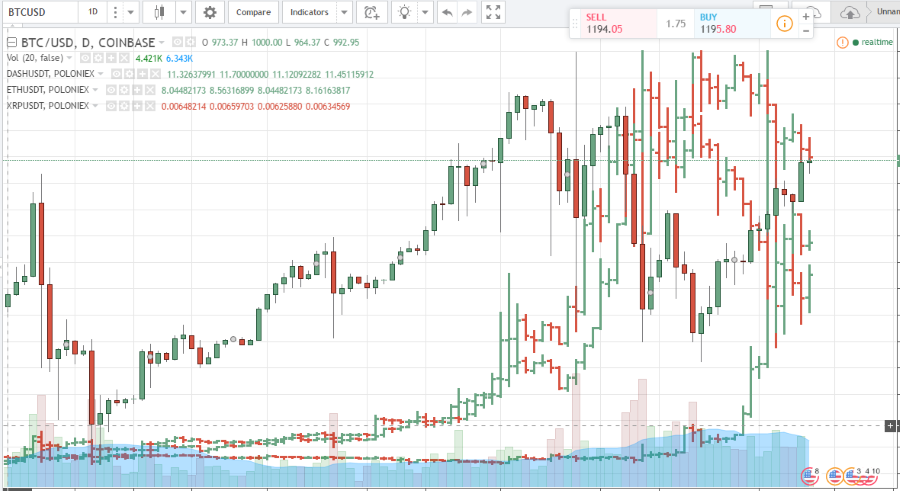
TradingView BRED Chart
Thanks, https://tradingview.com

So there we are, a simple portfolio with four of the biggest crypto assets. But…how did it perform?

Quadruple. Your. Money.

What will remain to be seen here is whether or not this is an aberration – past performance not indicative of future results and all that.

But holy buckets this thing is on fire.

Straight Up Fire

$10,000 invested equally on January 1 in four cryptocurrencies – Bitcoin, Ripple, Ethereum, and Dash – would have grown to $42,567.69 on April 1.

So…Now What, Smart Guy?

Yes, hindsight is 20/20. Looking back, the woulda-shoulda-coulda factor with the coins that aren’t named Bitcoin is pretty huge. And the volatility is such that today’s number on the BRED portfolio is more like $44,000 – and that’s due in part to the Ripple developments over the weekend.

But here’s our take – and we’re not investment professionals, nor do we provide legal advice – on what to do with this information:

Buy and hold. It doesn’t have to be these four cryptocurrencies, but you should consider having a few coins or tokens that you simply leave alone. Don’t trade them, keep them in cold storage, and worry about them only a little.
Written by David Van de Walle · Categorized: Bitcoin, BRED, Dash, Ethereum, Quadruple, Ripple · Tagged: Bitcoin, BRED, Dash, Ethereum, Ripple

Apr 07 2017

Launching an Altcoin? Write a Manifesto

do you manifesto?“Love me a good manifesto.” Actually, we’re struck by how many altcoins HAVE manifestos – and why they feel the need AND they choose the word “manifesto” in the first place.
Corporations have Mission Statements, Vision Statements, Core Values – and they normally put these things in initial caps and plaster them on walls throughout their organization. The thinking is that you get your morning coffee, I guess, and you walk by and read these statements, maybe genuflect, then get on with your day; but they’re always on your mind as you go forth and conquer the business world (likely for the benefit of the owners or shareholders of the company that just gave you your free morning coffee). (What if that coffee ISN’T free? I guess that’s a subject for another day.)

The Manifesto – beware, initial caps about to permeate this article – is an Italian term, and it appears the first Manifesto of note was written in Baghdad in the 11th Century. I, for one, always think of “The Communist Manifesto” as the most dominant manifesto to use “Manifesto” in the title – though it appears that a whole host of other documents – like the Declaration of Independence – can be called “manifestos.”

It sounds like there’s a reason, though, for these documents: you get fed up, or you don’t like the way things are going, or you’re just looking to make some changes and get others on board. So you write a manifesto, nail it to the wall somewhere, and you’re off to the races.

The Bitcoin Manifesto

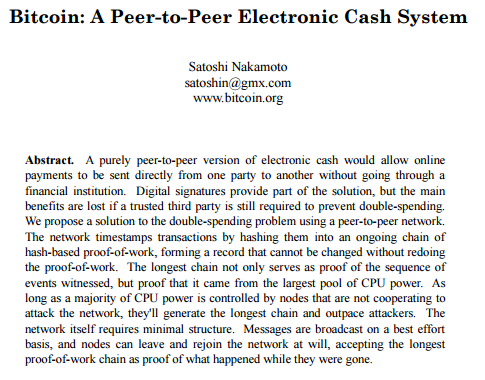
The cryptocurrency movement started with Satoshi Nakamoto’s original paper, “Bitcoin, a Peer-to-Peer Electronic Cash System,” which is considered required reading for those who want to understand how Bitcoin works (and, in turn, how all of these other follow-on currencies work).

BTC Manifesto

It’s a simple abstract (if you speak a little bit of programming language). And it started us down this path.

Why do you need a manifesto?

When we Googled “Bitcoin Manifesto,” the above popped up – even though it doesn’t have “manifesto” in the title. And then we Googled “Ethereum Manifesto” and this is what we got: Vitalik Buterin’s white paper, or write-up, or whatever…it, too, is not called a “manifesto.”

What’s interesting here, and what actually prompted this article, is the following chain of events:

  1. April 30, 2016. Ethereum launches its DAO – “Distributed Autonomous Organization” – and it takes off “like a runaway train” (as we learn in this awesome article on Quartz);
  2. June 17, 2016. The DAO is hacked, to the tune of $50m USD in Ether.
  3. July 2016. A “hard fork” is announced; this and subsequent hard fork in November 2016 are actually the third and fourth hard forks.

But somewhere in there, the old school and new school Ether disagreed: thus ETH and ETC. It was the DAO that got folks disagreeing: should it be altered? Should it be left untouched?

Enter PIVX and its manifesto

Honestly, we had heard about PIVX and we had seen a little bit of ticker-symbol chatter on Poloniex. However, since it’s not traded on Poloniex, we weren’t all that familiar with it.

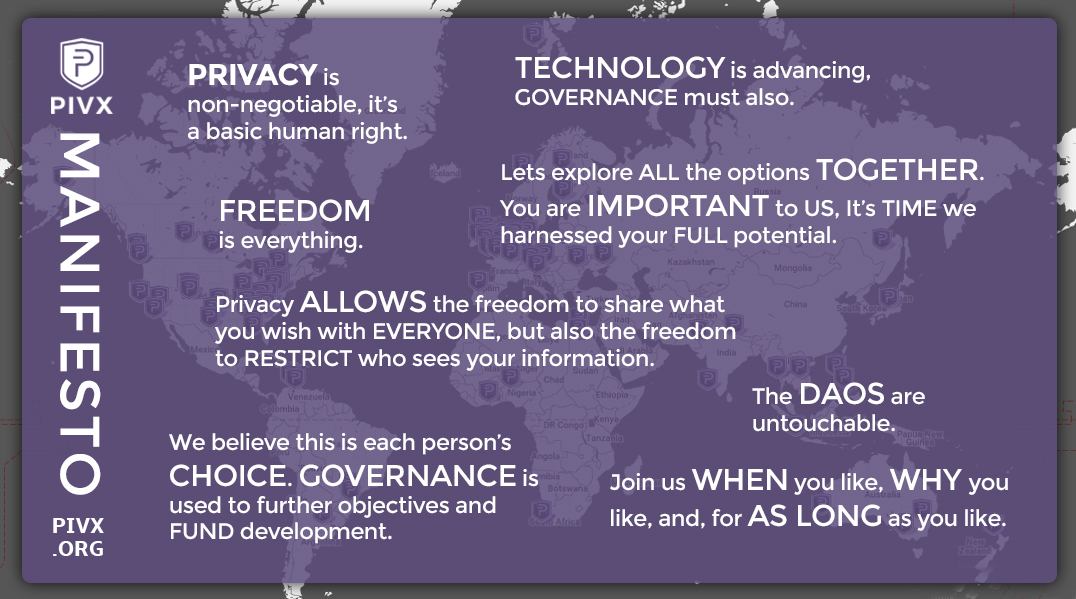
But their manifesto tells us quite a bit about how they feel about the DAO.

PIVX Manifesto

“The DAOS are untouchable.” (It should be “DAOs” but we’ll cut them some slack.)

PIVX also feels rather strongly about privacy, it seems. Take a look here at their “tale of the tape,” as they compare their coin to Dash:

PIVX Dash Infographic

Altcoin Manifesto Theatre

Let’s be honest here: we could probably spend all day talking about all sorts of coin manifestos – in fact, someone else did that here and why not just link to their post? – but the point of our post is that PIVX appears to want to hang its hat on a couple key themes: “Privacy” and “Governance” seem to be the two biggies (assuming you use “DAO” and “Governance” interchangeably).

Bringing us to the point of this article, and the key takeaway for you: “What does your coin stand for?” In other words, are you a “me, too” coin, created to take advantage of the fact that this is still the wild West and you can pretty much get funding for just about anything these days? Or are you putting a stake in the ground and saying “this is what we’re about.”

And I guess if you’re the latter…put it in a manifesto.

Written by David Van de Walle · Categorized: Manifesto, PIVX · Tagged: altcoins, Bitcoin, crypto, ETC, Ethereum, hard fork, manifesto, PIVX

Apr 02 2017

Weekend Ripple Developments

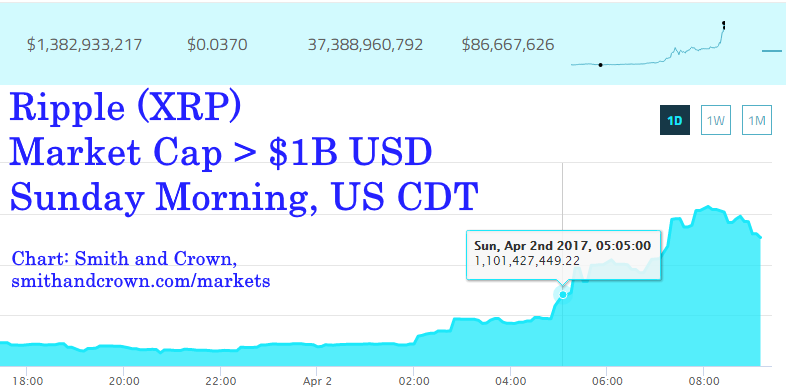
Hey! We drafted this on Sunday morning, then went about our business, then…well there was even MORE growth in the Ripple price. See below for our take on what this means, and check out Coinmarketcap.com for the latest price news.

While you may have been otherwise occupied this weekend, the altcoin markets were hard at work driving the price of Ripple (XRP) to heights that they haven’t seen in quite some time. First, some tweets to summarize the weekend Ripple developments.

whoa buddy – $1.5B market cap on $XRP – let’s discuss pic.twitter.com/9nPYtU52GD

— Meltem Demirors (@Melt_Dem) April 2, 2017

Never thought I’d see @Ripple‘s $XRP moon so hard ???????? 2nd most liquid #cryptocurrency over last 24 hrs. pic.twitter.com/9CiqmWaXxr

— Chris Burniske (@ARKblockchain) April 2, 2017

But wait, there’s more…

(Thanks to Smith and Crown for the chart.)

Now there are 3

Only three cryptocurrencies now own a market cap of $1B (USD) or higher: Bitcoin, Ethereum, and Ripple.

Why now – especially when Ripple not once but TWICE had a market cap of more than $1B?

(See below chart from CoinMarketCap.com.)

We’ll make a couple bets as to why that happened now, and what that means for your wallet.

Number 1: It’s becoming the back office that makes transactions possible. A good chunk of the Ripple community sees this as a missed opportunity for Ripple.

Number 2: The big banks are getting involved – and the news is somewhat buried. See this writeup from Cryptocoinsnews.com about MUFG (they’re huge) getting on board.

Next step? Who knows…

We’re pretty certain that what Ripple has earned over the past few days could be summed up in one word: legitimacy.

Since the beginning of time, money has needed to have perceived value in order to be legitimate. You could trade rocks for food back in the middle ages, but, at some point, the provider of food is going to want to see a rock that looks like it has some value. Shiny rock, or well-polished rock, or rock that sparkles like diamond or is made of something like silver or gold.

The fact that Ripple has (1) crossed into the 10-digit territory and (2) is being used by big banks adds a shiny, well-polished sparkle to its value proposition. And that means good things.

Written by David Van de Walle · Categorized: Coin News, Ripple, Trading

Mar 31 2017

Bitbond: It’s like Prosper, or LendingClub, but with Bitcoin

As we continue looking around the universe for Bitcoin and altcoin uses in the real world, we stumbled upon a site called Bitbond.

Bitbond(So if you think “Hey, I’ve got a great idea…” they’ve already checked that particular box.)

Peer-to-peer lending has been around for a little while, and two titans of this space are names you’ve likely heard of: Prosper and LendingClub.

Bitbond uses the same principle to let you use your Bitcoin as…principal. (That’s if you have Bitcoin to lend.) If you want to borrow, then there’s that, too – which the site says is ideally suited for folks like eBay power sellers.

If it sounds legit, well, it IS legit. Bitbond has been around since 2013 – see the complete write-up on Crunchbase – and they recently secured Series A funding north of 1000 BTC. (See what we did there?)

Is this better than the Shark Lady’s loan site?

This question is for the small business owners out there – and you know the site I’m talking about. The one that that lady from that show recommends. The only one she would use if she were looking for money.

Well, it quite possibly might be a process improvement. The Bitbond site walks you through what to expect once you’ve been funded. You have to work with an exchange, so you’re going to want to be sure it’s one that people have used for deposits and withdrawals and done so without fail.

And you’re subject to the credit check of Bitbond; given the fact this is a global and “bank-free” site, it’s still a question mark as to how that works.

Bitbond ScreenshotRates start at 7.7% and you can have your money in as little as five days.

Bitcoin and altcoin traders…

This also looks like a decent spot to put your coins to work, and – this could be big if you don’t have the stomach for wild mood swings – avoid the dips of your Bitcoin. (I mean, really, we’re talking about something that’s still rather volatile, right?)

The site tells us you can earn “13% interest.” That might sound too good to be true – or it might also sound paltry when compared to the day-trading gains you COULD make from trading the 100% gain du jour altcoin.

That’s up to you.

Other companies will follow…

Let’s think macro for a second. You’ve got the desire to move away from the traditional banking system, and you’ve got banks hustling to employ their own blockchain and cryptocurrency strategies. Plus you’ve got people thinking “OMG, the GOVERNMENT!!!!” or people worried about taxes or people worried about the trillions of dollars in derivatives that could implode any second now.

It makes sense, then, that borrrowing and lending will move this direction – outside the traditional brick-and-mortar, and traditional Central Bank mentality.

And if you look at this site – which is cool as heck – you’ll see that Bitcoin is just a small sliver of the overall pie.

Bottom line: more of this, please. Innovation in all stripes, thanks to blockchain technology.

Bitbond

Written by David Van de Walle · Categorized: Blockchain Startups, Lending · Tagged: Bitbond, Lending

Mar 26 2017

Let’s Talk About Dash

DashIf you follow the cryptocurrency space, you might have noticed some wild growth from an altcoin called Dash. On the surface, it might look like the growth stems mostly from hype – why else would a coin’s price go (in USD) from $22 to $115 in less than a month?
But beneath the surface, and beneath the FOMO and FUD, lies a rather sophisticated plan: Dash wants to actually become the everyday “Digital Cash” in your wallet.

“Dash is Digital Cash”

Well, if the website itself leads with that message, then it’s likely that’s what they’re going with: “Digital Cash.” And if you look at some of the places you can spend it and even the debit cards you can get that are tied to your Dash wallet, they’re onto something.

I Heart DashSo, generally speaking, it’s just like all the other coins – same concept as Bitcoin, up there near the top of the largest market cap currencies with Ethereum and Monero – leading us to wonder…what really makes it different?
“Dash is what I thought Bitcoin could be”

That quote comes from Amanda B. Johnson, who has fashioned herself as the leading expert on Dash. You can watch an entire interview with her here on something called the “Anarchast:”

If you listen to the interview, even just for a few minutes, you’ll be left with a couple very positive impressions:

  • Dash is the most instantaneous of the cryptocurrencies
  • Dash has a private setting that can let you remain anonymous
  • Amanda is a heck of a brand ambassador for the currency.

Where is this all going? Your wallet, your local store, and the new economy…if Dash itself has anything to do with it.

Dash Evolution

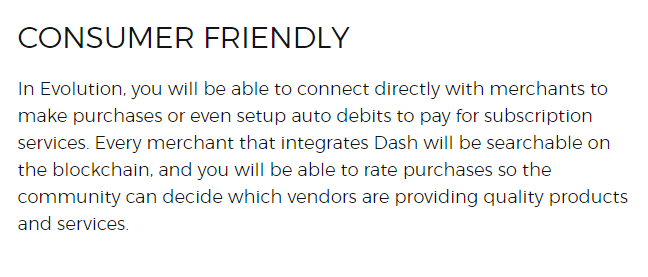
Evolution is their approach to taking digital cash mainstream, ending up on your phone, being used to pay for your latte or your parking or whatever. Don’t believe it? Here’s a screengrab:

Dash Website
Think they’re on to something?

“Connect directly with merchants” sounds like they want to cut out the banks and payment processors. (That’s intriguing.) Or there’s an Uber-like, Amazon-esque “you will be able to rate purchases so the community can decide which vendors are providing quality products and services.”

So not only will you be able to pay digitally with Dash, you can also – like Uber, or Amazon – give the merchant 5 stars. Or 1 star.

The future is now in your hands, consumer.

But…what about those merchants?

Evolution might be really bad news for…

Payment processors. Banks. But not merchants.

If you think about the way current payment processing works, you might get a migraine. There are layers and there’s a back-and-forth and everyone tries to get their cut – albeit small – before the money actually hits the merchant’s bank account. It’s that necessary evil that eats away at margins of the pizza place or coffee shop. It’s a whole bunch of “not fun.”

But take a look at this screener from the Dash website:

Dash Evolution
Why so dark?

“Forget about complex infrastructure or relying on third parties to handle…payments” and “build direct relationships with your customers using the blockchain.”

Which could also have been written: “avoid those companies trying to sell you payment processing because you won’t need them.”

What Does It All Mean?

Heart DashSaying it might mean good things for Dash, its users, and investors might be the understatement of the decade. You have a strong community, coupled with the infrastructure build to support use in the mainstream economy. And you have people like Amanda (really, we’re just scratching the surface, as there’s a whole host of people talking up Dash out there) stumping on the currency’s behalf.

Might be time to give it a serious look.


Written by David Van de Walle · Categorized: Dash

  • « Go to Previous Page
  • Page 1
  • Interim pages omitted …
  • Page 32
  • Page 33
  • Page 34
  • Page 35
  • Go to Next Page »

Copyright © 2026 · Altitude Pro on Genesis Framework · WordPress · Log in