• Skip to main content

Metacoin

Covering Bitcoin, the Blockchain, Altcoins, and Fintech

  • Start Here
  • Links
  • Disclosures
  • NFTs
  • Collezione

Bitcoin

Nov 03 2017

On Bitcoin $7000, Bitpetite SCAM, and Crypto Legitimacy

First of all, if you’ve been following this site, you know that we try to be as up front as possible. If we see a scam, we’ll point it out. We encourage you to do your own research (DYOR). We are adamant that you should not invest more than you can afford to lose. And we stress, sometimes in bold and italics, that this is all an experiment.

We took a break from blogging for a couple weeks – some of that was to be in our version of a decompression chamber of sorts. Let’s watch the action, let’s watch our baskets of eggs, and let’s ensure that we get our house in order in the background. In our absence – our last post on Bitconnect was on October 17 – we saw a couple things happen, and we’ll try to break them down for you now.

BTW, this might be as good a time as any for the only banner ad we can run on the site right now – that’s right, we’ll talk about how we, too, were scammed by Bitpetite and we’ve had to go back and scrub their ads. So here’s an AFFILIATE LINK for BITCONNECT. DYOR. Don’t invest more than you can afford to lose.

Thing 1: Bitcoin $7000

Hitting $7000 (USD) per Bitcoin seems like a really big deal, given our collective propensity to fall in love with large, round numbers.

Then, if you look back at past posts that talk about our BRED Portfolio, you’ll see that Bitcoin was at $4365 on October 1; this means that you could have brought home a 60 percent gain on your money in a shade more than a month.

That makes it a really HUGE deal.

Then, if you factor in the Bitcoin Cash (BCH) price plus consider the fact that one Bitcoin on January 1 of this year was $973, you’re actually sitting on at least a 6x return.

That is HUGH. MONGOUS.

But, in some respects, it is beside the point – the price of BTC doesn’t matter so much as the number of BTC you are able to accumulate.

You could possibly say that about dozens of coins or tokens – yes there will be some wheat and lots of chaff, but the super, blight-resistant, able to feed millions with one stalk kind of wheat that will emerge will be so valuable that the kings and queens of this new economy won’t much care the USD price.

Seriously – there’s a oft-repeated belief in the Bitcoin world that BTC is, indeed, going to $1 Million. Won’t be next year, in all likelihood (though stranger things have happened), and may not happen in the next twenty years. But it will happen.

We’ve had people ask two things: (1) is it too late to buy? and (2) is this a bubble? I’ll answer the first: no. Actually, let me be more emphatic: NO. If you’re not in the game, you’re not in the game – and because of the beauty of Bitcoin, you can drop $100 and get started and maybe trade a little or sock it away or whatever. (We recommend Coinbase, here’s an AFFILIATE LINK, and your $100 investment will get you a $10 bonus, something we’ll also get.)

But, wise sages at Metacoin HQ, is this a bubble?

Maybe it is. Maybe it isn’t. In some respects, that is not the point here – the point is that we are in accumulation mode, it’s a landgrab of sorts, and whether Bitcoin goes to $1 Million or drops to $1 might be beside the point. Here’s why:

Because of the way Bitcoin itself was set up and is structured and governed, 21,000,000 is the cap. No more will ever be issued.

While some are asking the bubble question, others – countless others – are building businesses and services and solutions that keep the Bitcoin movement alive and thriving. Bitcoin may end up being used to pay for cups of coffee, or it may end up being used to buy SUVs, or it may be replaced by an even better coin that is ubiquitous. In any event, if the price crashed today, the entire system wouldn’t immediately crash. Miners will still mine. Traders will still trade. Speculators will still speculate. If you think of Bitcoin as a country that has launched a brand new currency, maybe ask if anyone is using that currency or has the potential to use that currency. In that respect, we are just getting warmed up.

In other words…get in the game. Now.

[QUICK “SPONSOR BREAK” – If you haven’t signed up for the POW Token “Airdrop,” it’s not too late. Use this AFFILIATE LINK – POW Token Airdrop – then get ready for the next airdrop, coming next week.]

Thing 2: Bitpetite SCAM

Did we mention lately that this WHOLE THING is AN EXPERIMENT? Well it is.

As we’ve told you here a few times, we’ll put some of our own capital at risk with some of these Passive Income Platforms that we discuss. And, well, there seems to be a pretty below-average track record for these. Is it our luck? Is it the nature of the beast? Is it a combination?

The latest to go belly up is Bitpetite, and we’re annoyed – but not surprised. In fact, because of our experiments with Ambis and Control Finance and Bithaul, we have made it a habit of taking coins and tokens out at every opportunity. We encourage you to do the same.

We’re going to keep experimenting and putting our money at risk AND STRESSING THAT YOU SHOULD DO YOUR OWN RESEARCH AND PAST PERFORMANCE DOES NOT INDICATE FUTURE RESULTS.

We now have just one PIP that we’re using – Bitconnect – but we’re looking at a few more. Stay tuned.

Bitpetite is gone – and we apologize for linking to it and promoting it. As we said, it’s an experiment. These things could fizzle.

This gives us an opportunity to suggest that you spread out your risk. It’s really the only way to go – multiple baskets, multiple investments, and multiple streams of crypto income.

Thing 3: Crypto Legitimacy

Honestly, there may not have been a better piece of news than the CME group announcing that Bitcoin futures would be available by the end of the year. In fact, that alone might drive the legitimacy that the Winkelvoss brothers were waiting for when they applied to have their ETF traded.

We cannot underscore enough that, even if there’s a large pullback in the price of Bitcoin, and if Ethereum and Litecoin and Ripple and a bunch of altcoins follow…it might not matter a ton because Bitcoin, blockchains and cryptocurrencies are, indeed, here to stay.

We’ll give you one brief example: we’ve been talking about POW Token a bit, and one of the things that we’ve done on the site is “validate” users. We do this for small numbers of tokens – but we’ve also learned a ton about where these folks are coming from.

To validate folks, we have to click on their Facebook profile and find evidence that it wasn’t a Facebook profile that was just recently created to get free tokens.

And…they’re not. But that’s not the point: these folks are from everywhere. Asia. South America. Europe. The Middle East. Even a few Americans!

Whether or not POW Token will become the next world beater is not actually the question to ask: it’s whether or not cryptocurrencies have hit critical mass (they have) and whether or not there’s the potential for value to be exchanged and these things are easy to use (they are).

The takeaway? Folks, with all this…the belief is that we are just getting started. So glad you’re along for the roller coaster ride.

Written by David Van de Walle · Categorized: Airdrop, Bitcoin, Bitpetite, Coinbase, Ethereum, POW Token, Tulips

Oct 17 2017

99 Days of Bitconnect

UPDATED ON NOVEMBER 2 – Bitconnect is still cool, but we’re striking through all the text about Bitpetite, which is a scam.

Here on the site, we’ve talked quite a bit about the concept of “Passive Income,” and, specifically, Passive Income Platforms (PIPs) where you can invest your coins or tokens and watch them make money for you.

We’ve also tried to be as upfront and transparent as possible. This approach, we think, lets us share with you a “warts and all” look at these PIPs and whether or not they might be worth your hard-earned Bitcoins.

Bithaul
Bithaul is a SCAM.

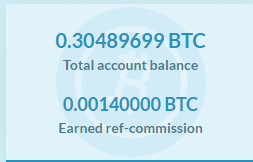
We started our journey with Bitconnect (AFFILIATE LINK), and we’ve also tried a couple duds – “scams” is actually more accurate – like Bithaul (the image over there is what they SAY we have in our account right now, though we haven’t been able to withdraw for almost a month), or Control Finance (another dead site), or Ambis (SCAM).

(The only other platform that we’ve tried and can still vouch for is Bitpetite (AFFILIATE LINK), which continues to have a great track record for us. And we promise to try more of these in the days to come, with a report on them as we proceed.)  Bitpetite is a SCAM.

Bitconnect remains the leader for us because of a couple of factors:

  • It is backed by an actual coin;
  • That coin has a large market cap;
  • There is a wide distribution, throughout the world, of Bitconnect users;
  • The track record of payouts is pretty strong (see chart below).

99 Days In…

Okay, the image we’re about to share will take a little scrolling on your part. It’s a screenshot of our Excel spreadsheet that tracks the amount of interest paid each day we’ve been part of the Bitconnect system. SO it’s 99 days of history, going back to July 10, when we got started. Let’s take a look:

Before we psychoanalyze this spreadsheet, we should probably give you a refresher on the basics.

  • For instance, you need to invest a minimum of $100 to get started. You need to convert Bitcoin into BCC, their coin, and then invest a round number in an increment of $10. We landed on $110 to get started because of exchange rates and whatnot on the day we invested.
  • $10 is a pretty important number for the site, too, because you can only reinvest in multiples of $10.
  • You are given the option to cash out your interest whenever; but we have chosen to reinvest it at each step of the way.
  • Since we’re not “whales” on the site – at least not yet – our investments and reinvestments are locked down for 299 days; to get your money back sooner, you will need to invest a minimum of $1010.

We’ve tried to manage this spreadsheet so that it’s obvious to us when we reach a milestone: the “Reinvest” column is highlighted when we reinvest into the system. Another key milestone for us was September 14: that’s the date we took some affiliate commissions from Bitpetite (AFFILIATE LINK; you, too, can sign up and get affiliates on the site and get commissions should you so choose) and invested them into Bitconnect. (That’s why the upper right corner, where it says “initial investments,” reads “$310.”) (ALSO, ignore the “Today’s Total” figure; we’ll fix once the coffee consumption is at normal levels.)

Pluses and Minuses

One thing you’ll need to consider here: are you better off parking some of your coins somewhere (like Bitconnect) or just keeping them in Bitcoins and doing nothing.

This is a legitimate question – we look at our own approach as “risk management” and we aren’t planning on putting all of our eggs in any one basket. Still…

This chart shows the Bitcoin price on July 10 – the day we got started on Bitconnect – and tells us that we would have also done well had we just taken $110 worth of Bitcoin and parked it in Bitcoin. At today’s price of around $5640, that’s more than a 132% return.

BUT, if you see look at our Excel chart above, you’ll see that we did just as well, in a shorter time frame, with our original investment; $110 had turned into $260 on Sept 13, the day before we dropped another $200 into the platform.

In addition to the other concerns that you should have with any Bitcoin-related investment – that you could lose your entire principal, that the site could disappear on you, that you’ll invest your time and money in something you’re better off avoiding – another concern is whether you are better off with the core coins (like our BRED Portfolio) as opposed to these passive income platforms.

This is a legitimate question – might end up being a “minus” in the grand scheme – if you take some of those Bitcoin estimates that are floating around and tease them out. For instance, one prognosticator we found on the internet made a semi-legitimate case for Bitcoin to hit $27,000 at some point in early 2018. By then, our original Bitconnect investment would be worth around $1500, but would pale in comparison to the same amount just parked in Bitcoin (which would quintuple in Q1 2018).

As Always, Watch Your Eggs

The multi-basket, disciplined approach is a good one; and there’s also something to be said for the fact that parking your Bitcoins at Bitconnect actually parks them for 299 days. It’s not like there’s a “substantial penalty for early withdrawal,” since there is, more accurately, “no possibility of early withdrawal.”

So we should summarize the same way we summarize all of our discussions of these platforms: Do Your Own Research, don’t invest more than you can afford to lose, manage your risk appropriately, and…good luck.


Written by David Van de Walle · Categorized: Bitcoin, Bitconnect, Bithaul, Bitpetite, Control Finance, Passive Income

Oct 11 2017

Getting Started (Redux)

Several weeks ago, we posted a few ideas to get you started with cryptocurrency. You know, Bitcoin, Ethereum, and some of the other coins and tokens that we discuss on this here forum.

We thought that we’d spend some time today revisiting that idea: How Do You Get Started?

Our goal today is AN ACTIONABLE LIST. A few things to possibly whet your appetite.

We have a few ideas below – and, since this continues to be an experiment, some of the links are going to be different from the last time we did this. As usual, we’ll include a few AFFILIATE LINKS with this post (so we may be compensated if you take some sort of action, like signing up, buying currency, or investing) and we’ll be as blatant as we possibly can when we share one.

Let’s begin.

An Airdrop and This Will Cost You NOTHING

We talked about this “airdrop” last week and it’s still going on. Here’s a link to the POW Token webpage. Simply put, you sign up with your Facebook credentials and the token creators give you a bunch of tokens (or coins).

We have been asked “Why Are They Doing This?” and the best answer to that is that there’s value in a widely distributed network. While the creators make some…interesting…claims on their web page, there is something to the fact that a network with a million people using its product will be much more valuable in the long term than a network with just 30,000 users (which is where it stands today).

For now, think of this as a Western US land grab, and you’re putting stakes in the ground and hoping that it becomes fertile farmland in the future.

Coinbase – STILL the Fastest Way to Get Started

This one will cost you money, but one of the beautiful things about Coinbase (AFFILIATE LINK) is that, for Americans at least, there’s a decent amount of seamless integration between traditional banking and this new economy. The AFFILIATE LINK gives you a $10 bonus (paid in Bitcoin) if you spend $100 on any combination of the three currencies they offer (Bitcoin, Ethereum, or Litecoin). (And once you join in, you’ll get your own link and can invite others yourself and possibly be compensated…which is cool with us.)

Trade Coins on an Exchange

While there are a few established exchanges that we’d suggest – Bittrex, Cryptopia (AFFILIATE LINK) and Poloniex are three that we currently use – you should also consider signing up for one of the newer exchanges, too.

  • Altcoin Exchange (AFFILIATE LINK) may very well be lucrative for you – we know that other exchanges that started this way (through referrals) compensated their early adopters rather richly. Use our AFFILIATE LINK over there, and then start referring others yourself as you see fit.
  • WCX  (AFFILIATE LINK) is another one, with an ICO coming in a few weeks.
  • COSS is brand new. Not an affiliate link, but we do like the fact it’s based in Singapore and has developers throughout the world.

Passive Income Platforms

Yes, we have been talking A LOT about Passive Income Platforms, or PIPs, that can help you profit with limited amounts of effort. We currently recommend two of them – that’s not to say there aren’t others that are worth your time and investment, but these are the two that we (1) have experimented with and (2) have not let us down.

DO YOUR OWN RESEARCH! Seriously, with any of these, your coins could end up in a black hole of nothing. Don’t invest more than you can afford to lose.

  • Bitconnect (AFFILIATE LINK) is beautiful, we think, because it is backed by an actual coin, one that has a large market cap (as of this writing, around $1 Billion). The odds of it disappearing are small.
  • Bitpetite (AFFILIATE LINK) acts more like a mining platform, in that your “investment” will not be returned to you. However, we now have a nine-week track record of daily payments from the site; note that payments are larger during weekdays than weekends.

An Actionable List?

That’s our hope. You can spend a couple minutes on the first one and it costs you nothing, then, if you’re ready to invest some real money, you can consider trying the other ones out.

In any event, don’t invest more than you can afford to lose…once you get started in this world, it might get a little addictive.

Written by David Van de Walle · Categorized: Airdrop, Bitcoin, Bitconnect, Bitpetite, Coinbase, DYOR, Ethereum, Litecoin, Passive Income, POW Token

Oct 09 2017

It’s October, and Time to Check In on BRED

Followers of this site know that we talk about a diverse set of Bitcoin and cryptocurrency-related topics, and we’ve actually been doing so for seven solid months. (That seems like forever in crypto – in some respects, this hyper-warp-superspeed in the industry is actually unlike anything else we’ve ever seen.) And, while it may appear that we’ve zeroed in on Passive Income of late – we have, to an extent – we don’t want to forget about one of the “innovations” we created in April: the BRED Portfolio.

BRED is Like FANG for Crypto

FANG – Facebook, Amazon, Netflix, Google – gives investors exposure to the internet, social, digital, and the web, acting as a quasi-index fund for those who invest in that group. BRED aims to do the same: take a group of four cryptocurrencies that give broad exposure to the market, but each does its own thing:

  • B is for Bitcoin (the “well, duh!” piece of the portfolio)
  • R is for Ripple, which aims to upend SWIFT as the industry standard for interbank transfers, globally
  • E is for Ethereum and OMG it seems like every ICO is using Ethereum’s smart contracts as their backing
  • D is for Dash, whose consumer focus and community caught our eye from the get-go.

We started with a simple premise: a non-weighted fund that bought $2,500 of each of the four currencies and left it alone.

So, how is our hypothetical $10,000 doing?

September Was a Down Month

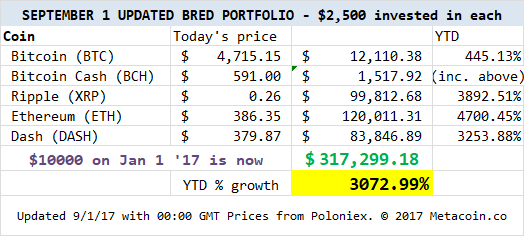
BRED October 1

This is good, right? Your YTD growth is 2416%; you would have taken $10,000 and turned it into $250K.

Yes, you would have. But you also would have witnessed a bit of a pullback from the month previous:

But what’s $61,000 among friends?

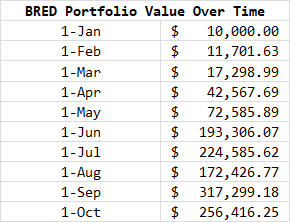
Really, Though…Quite a Year!

Here’s what your month-by-month looks like: 10 month BRED

So, if you want to talk about a “buy and hold” strategy for Bitcoin and its ilk, you may want to consider the BRED Portfolio.


Written by David Van de Walle · Categorized: Bitcoin, BRED, Dash, Ethereum, Ripple, Uncategorized

Sep 16 2017

How To Avoid Getting Rekt

Easy

If only it were that easy.

Spending 48 hours watching the Bitcoin market (and the other crypto markets, too) was enough to elicit trips to the store for industrial-strength antacids. You had a weird week – China news ping-ponging throughout the market, Jamie Dimon saying that Bitcoin was headed to zero (or something like that) – and the price craziness did cause quite a few “hold my manbun while I vomit” moments.

However, now that all that’s in the rear view mirror (because we’ll never have a price drop ever again, right?) it’s time to talk about how you can avoid getting rekt.

We’ve got four parts to this approach – four pillars of risk management that you can consider. Those four pillars: The Ratio, The Basket Theory, Passive Income Platforms, and ICOs. We’ll explain it all below.

Again, Do Your Own Research. Here goes…

Risk Management, Part One – The Ratio

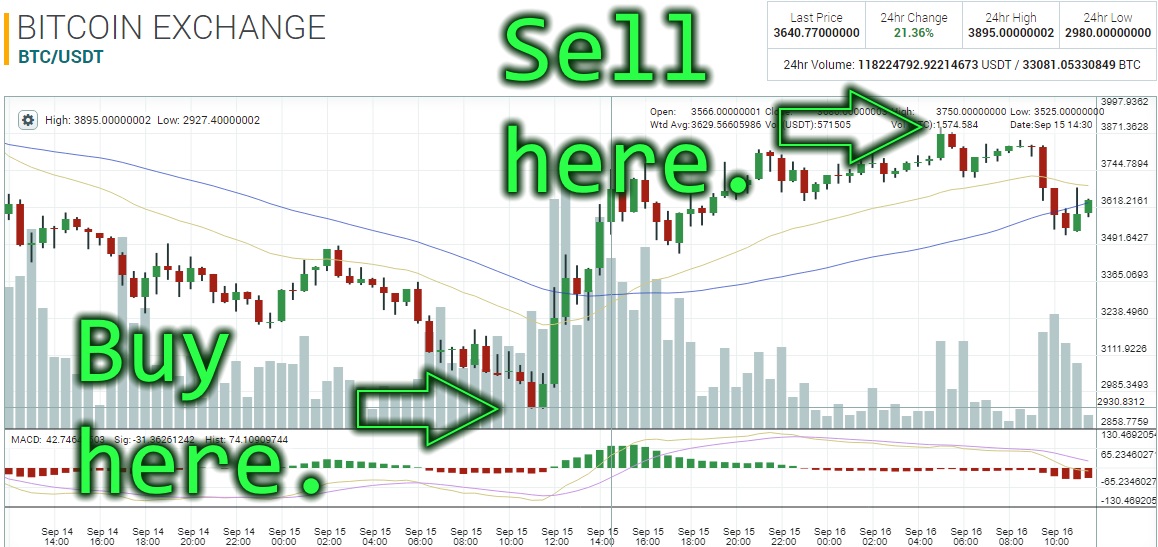
Traders – the hardcore type – talk about “risk/reward” ratios in a very simple way: expressed as a ratio with a colon between the numbers (giving us an opportunity to maximize the use of various punctuation marks in one glorious sentence; we are big fans of glorious sentences here at Metacoin HQ) and it looks something like the below image.

In this situation, you are advised – by the hardcore traders, not by Metacoin, since this site does not offer individualized trading advice and you should do your own research and you and you alone are responsible for gains or losses and don’t invest more than you can afford to lose – to risk 1 to potentially make 5.

A trader would say, for instance, that they see the potential for a profit of 50% on a trade. If that’s the case, you’re setting a stop loss at 10%. Applying it to the above Bitcoin price, if you listened to this trader’s hypothetical advice when Bitcoin was at $3000, you’d have stop losses to sell your holdings at $2700, and you’d have a sell order at $4500. (And you might actually see both of those prices in the next couple weeks, at least given the volatility in the marketplace.) Neither have been triggered, but, if the price hits either level, you’ll either sell and cut your losses, or sell and take some profits.

But you can also apply a different sort of risk management concept, which I’ll call the “Basket Theory.”

Risk Management, Part Two – The Basket Theory

Andrew Carnegie famously said “Put all your eggs in one basket, then watch that basket.” The general premise for Carnegie started with steel, which he used as a fulcrum to get into all sorts of other things; so maybe his basket of steel gave birth to other baskets (bonds, oil, general finance, etc.) and you could use his theory to some extent with crypto. In other words, you need to know a lot about cryptocurrency if you’re going to have a basket of crypto, but you need to diversify that basket itself.

Carnegie’s advice could be boiled down to this: you’re getting into eggs, but that doesn’t mean you shouldn’t have a variety of eggs, either.

Bringing us to the other old adage: don’t put all your eggs in one basket.

Basic risk management in any sort of trading involves a diversified portfolio. You could call the BRED Portfolio we talk about as diversified, but, in all honesty, it’s not diversified enough.

Our own Hedge Fund is probably a better choice for this – a basket of a variety of currencies, chosen for their diversity. If one goes way up, there may be others that don’t do as well – and that’s okay, because the basket itself gets bigger and is more diversified than betting on just one crypto.

But there’s one other angle to our own recommended approach to risk management: Passive Income Platforms.

Risk Management, Part Three – Passive Income Platforms

We have talked at length about some of these platforms, and we are really only scratching the surface. There’s money to be made if you know where to look – and we cannot stress the following point enough:

Spread out your risk in Passive Income Platforms, or you will regret it.

This part of our crypto journey began in July with a Bitconnect investment. (AFFILIATE LINK over there.) Bitconnect (which we explain more on the Passive Income page, which includes some running totals and updates from our various experiments) has the potential to be the best long-term passive income platform in cryptocurrency. This is because the platform is backed by a coin that has a market capitalization of $700-plus million.

We couldn’t go crazy with Bitconnect, though, because we have to keep banging the drum on diversification and risk management and egg-watching. This led us to more platforms worth trying out: Bitpetite (AFFILIATE LINK; Bitpetite “borrows” your Bitcoin, Ethereum, or Litecoin to profit from transaction fees, they pay you, but it’s a lease, like Genesis Mining, and you won’t get your original principal back) and Bithaul (AFFILIATE LINK; brand new, we’ve pulled some BTC out of it, but it’s a test and we’re not sold yet).

But, our research also led us to three additional platforms that went belly up: Ambis, Microhash, and Control Finance.

Affiliate commissions and referral fees can offset some losses, and some of these programs are potentially pretty lucrative. Plus, if you don’t like the “multi-level marketing” component of some of these (Bitconnect and Bitpetite both have tiers of affiliate commissions, so you can potentially profit from introducing others who introduce others), you can just sign up for trading platforms that are launching – like Altcoin Exchange, or WCX – and potentially profit from trading that happens down the road. (Those are REFERRAL LINKS.)

We’ve got one more in our four-part guide…And it’s one that American blokes like us are often kept from taking advantage of. But you…if you’re not in the US or one of the other verboten countries, should totally look at ICOs.

Risk Management, Part Four – ICOs

Initial Coin Offerings – ICOs – are the new Initial Public Offerings – IPOs. We’ve gotten into two ICOs; that number is only two because of the following:

  1. We’ve been skeptical of the product and/or
  2. We’ve been slow to the draw and/or
  3. We’re American.

That last point is uncool, in our opinion. Because of the lack of clarity around regulation, many ICOs are deciding that they just don’t want to muck with American involvement. Some of the cooler ones (Presearch, for instance) asks you at the front page whether or not you are a US citizen or US resident. Answer yes and they’ll thank you for playing and send you on your way; you can’t even register because you aren’t worth the hassle.

You have to wait, in those cases, until the coins trade on an exchange. If it’s a project worth investing in in the first place, its price will pop on the exchange. If it’s not worth investing in at ICO levels, you can possibly get coins on the cheap once they trade – but once they do trade, if they’re trading at a discount, there’s a reason.

We’ll use baseball vernacular to explain our two investments: we’re 1-for-2 – a hit and we reached on a fielder’s choice.

  • Tierion – this is a base hit, maybe could be a double. We’ll probably score a run with this one. Great project, and it’s right now trading 80 percent higher than its ICO price.
  • Exscudo – if you’re not a baseball person, a fielder’s choice is when you get on base thanks to hitting the ball, but a fielder makes a play elsewhere, allowing you to reach base. It’s not a hit. It’s not an out. You’re on base. You could eventually score a run, or you could be stranded there after the third out.

With Exscudo, it remains to be seen how successful it will be – if it’s successful at all. Unlike Tierion (which trades on HitBTC, a market for post-ICO coins that aren’t found on regular exchanges, like Poloniex or Cryptopia), Exscudo hasn’t traded anywhere yet – the project is forthcoming. We’re planning, honestly, to get stranded on base (or, even worse, to get picked off daydreaming after wandering off first base). They launch their “test net” on October 4, and the entire project has been delayed.

(We participated in their “Bounty Program,” giving us the chance for pretty substantial gains – but we’re preparing for the worst.)

Is there more to Risk Management? Sure!

We haven’t talked about mining and staking yet – I guess we could talk about those, and we might update this guide down the road. But, for now, we think that these four pillars could help you figure out how best to manage your own crypto risk.

Hang in there, friends. It’s just starting to get interesting.


Written by David Van de Walle · Categorized: Bitcoin, Bitconnect, Bitpetite, DYOR, Exscudo, Passive Income, Risk Management, Tierion · Tagged: rekt

  • « Go to Previous Page
  • Page 1
  • Interim pages omitted …
  • Page 8
  • Page 9
  • Page 10
  • Page 11
  • Page 12
  • Interim pages omitted …
  • Page 18
  • Go to Next Page »

Copyright © 2026 · Altitude Pro on Genesis Framework · WordPress · Log in